
Cart
No products in the cart.
 English
 Български (Bulgarian)
 Hrvatski (Croatian)
 Čeština (Czech)
 Dansk (Danish)
 Nederlands (Dutch)
 Suomi (Finnish)
 Français (French)
 Deutsch (German)
 Ελληνικά (Greek)
 Magyar (Hungarian)
 Italiano (Italian)
 Norsk bokmål (Norwegian Bokmål)
 Polski (Polish)
 Português (Portuguese (Portugal))
 Română (Romanian)
 Русский (Russian)
 Español (Spanish)
 Svenska (Swedish)
 Türkçe (Turkish)
Showing all 12 resultsSorted by popularity
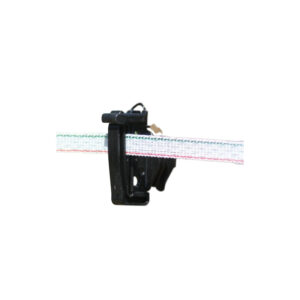
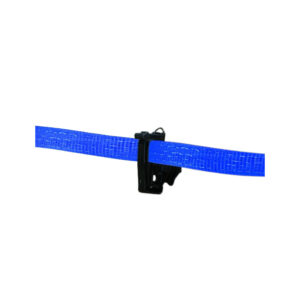
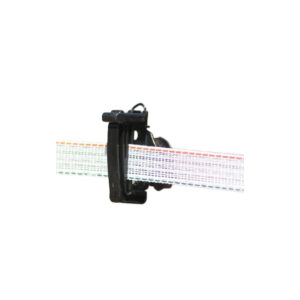
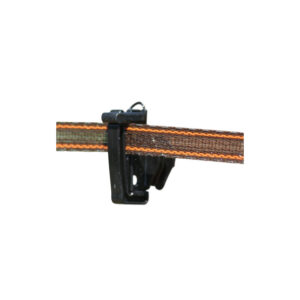
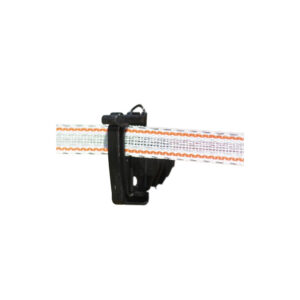
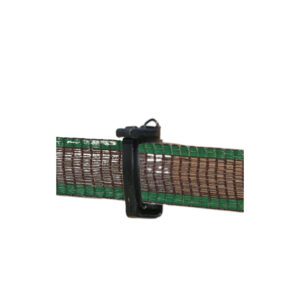
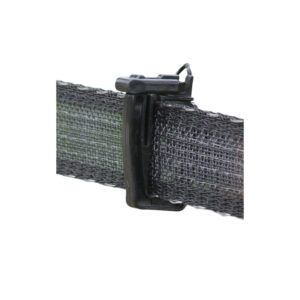
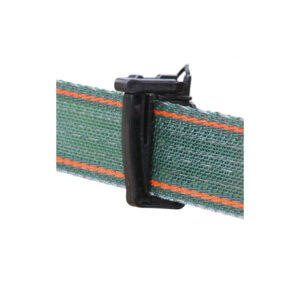
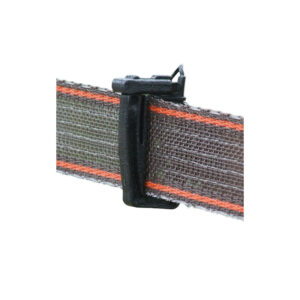
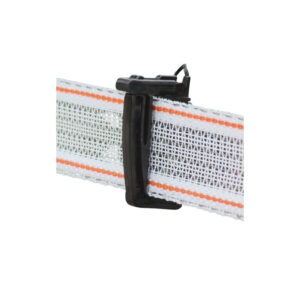
Tape for electric fence refers to flat, woven conductive ribbon used in high-voltage fencing systems. These tapes consist of multiple metal conductors embedded in synthetic polymer yarns to deliver electric charge while retaining mechanical strength. In industrial and agricultural settings, professionals seek tape with specific resistance, breaking force, width, and conductor configuration to match fence length, livestock safety, and durability requirements.
This category presents various electric fence tapes such as standard polyethylene ribbons and reinforced versions. Key offerings include tapes in widths like 12.5 mm, 20 mm, 40 mm; color options such as white, blue, brown, green, or white with green and red border; and reinforced tapes with extra edge strength. Each product differs in resistance per meter, breaking force ratings, conductor count (for example stainless steel, copper combinations), and cross-connections between conductors. Package lengths vary from about 200 m to 400 m.
These electric fence tapes are used in containment and deterrence systems for livestock, wildlife management, and perimeter control. In grazing operations, tapes guide cattle or sheep positioning, while in game ranches blue or visible tape helps deter big game such as wild pigs or wolves. Reinforced tapes are suitable for longer spans of fencing or exposed locations requiring higher breaking force. Secondary considerations include visibility, resistance (ohm/meter), conductor count, and weathering properties for outdoor performance.
The primary function of electric fence tape is to conduct high-voltage pulses across a barrier using multiple embedded conductors, while also serving as the visible physical boundary. Key technical characteristics include material composition—commonly polyethylene embedding stainless steel, copper or inox conductors; width measurements from roughly 12.5 mm to 40 mm; resistance ratings per meter that affect voltage drop over distance; breaking force values spanning dozens to several hundreds of kilograms; and conductor configuration, including number of wires and frequent cross-connections (e.g., every 14 cm) to maintain current continuity.
Typical use cases are medium- to long-span sections of electric fence where maintaining pulse integrity is crucial, or in areas requiring high visibility to both humans and animals. Variations include standard tapes versus reinforced tapes—the latter having thicker edges or extra strands for enhanced mechanical durability. Width and conductor count influence visibility, load-bearing, and maximum effective fence length. Compliance attributes may include CE marking or equivalents, ensuring safety and suitability for outdoor electrical standards. When selecting tape, consider environmental exposure (moisture, UV), electrical compatibility (resistance, pulse energy), mechanical stress, and alignment with fence energizer specifications.
Through MEMIDOS you access a global B2B platform offering direct relationships with manufacturers and suppliers. Without intermediaries, procurement becomes more efficient and pricing reflects true industrial margins. Buyer protection is enabled by escrow-based payment handling, where funds are held until shipment conditions are met, ensuring both supplier reliability and payment security. All products are sourced from verified suppliers, enhancing transparency in material specifications and quality. For procurement professionals managing cross-border sourcing, the platform simplifies international trade and ensures clear documentation of technical parameters, while reducing complexity in tender and specification processes.
English
Български (Bulgarian)
Hrvatski (Croatian)
Čeština (Czech)
Dansk (Danish)
Nederlands (Dutch)
Suomi (Finnish)
Français (French)
Deutsch (German)
Ελληνικά (Greek)
Magyar (Hungarian)
Italiano (Italian)
Norsk bokmål (Norwegian Bokmål)
Polski (Polish)
Português (Portuguese (Portugal))
Română (Romanian)
Русский (Russian)
Español (Spanish)
Svenska (Swedish)
Türkçe (Turkish)