
Cart
No products in the cart.
 English
 Български (Bulgarian)
 Hrvatski (Croatian)
 Čeština (Czech)
 Dansk (Danish)
 Nederlands (Dutch)
 Suomi (Finnish)
 Français (French)
 Deutsch (German)
 Ελληνικά (Greek)
 Magyar (Hungarian)
 Italiano (Italian)
 Norsk bokmål (Norwegian Bokmål)
 Polski (Polish)
 Português (Portuguese (Portugal))
 Română (Romanian)
 Русский (Russian)
 Español (Spanish)
 Svenska (Swedish)
 Türkçe (Turkish)
Showing all 6 resultsSorted by popularity
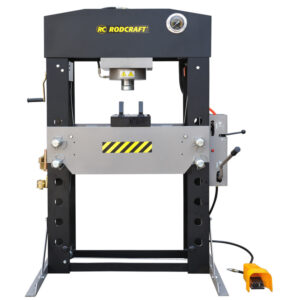
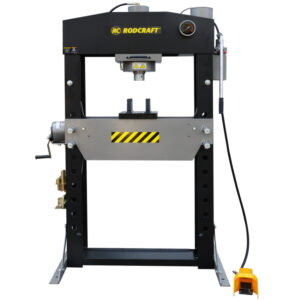
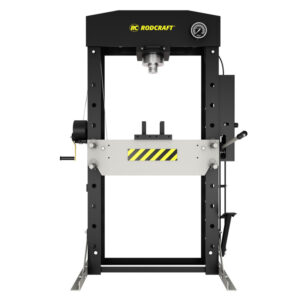
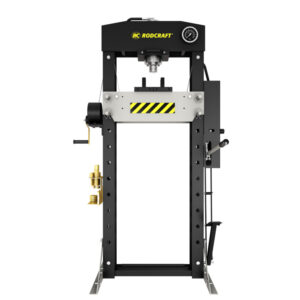
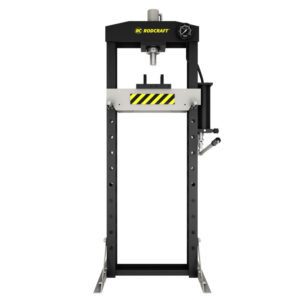
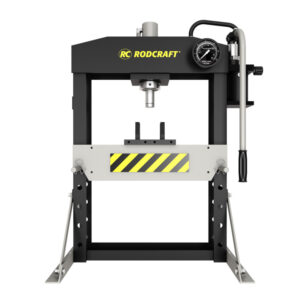
Workshop presses are industrial tools designed to apply pressing force for shaping, forming, or extracting parts in an automotive, metalworking, or fabrication environment. This category includes hydraulic workshop presses with various tonnage and stroke specifications. They are used by professionals who require reliable equipment for heavy-duty tasks in manufacturing or maintenance, where hydraulic capacity, frame strength, and pressing force are key considerations.
The category features hydraulic workshop presses in increments of 15, 20, 30, 50, 75, and 100 tonnes of capacity. Values for hydraulic stroke range between 160 mm and 300 mm, depending on size. Each press includes a steel frame and accessories like pressure piston sets, quick-change adaptors or holders. The range includes smaller capacity presses (15 tonnes) suitable for lighter pressing tasks and larger capacity models (up to 100 tonnes) for high-force applications, with corresponding increases in frame height, width, and unit weight.
These hydraulic workshop presses are applied in automotive repair shops for removing and installing bearings or bushings, in metal fabrication for bending or straightening parts, and in maintenance or industrial assembly tasks where high compressive force and precise alignment are required. They are commonly used for bending, bearing extraction, and high-force pressing operations. Such tools are also used in prototyping or restoration work, where controlled pressing is essential for fit-up or aligning structural components.
Workshop presses operate by converting hydraulic pressure into mechanical force delivered through a piston and hydraulic cylinder. Key technical metrics include pressing force (measured in tonnes), stroke length (mm), frame material and construction, and inclusions like pressure piston sets, quick-change adaptors or holders. Steel frames are welded and dimensioned to handle force while maintaining alignment and safety.
Typical capacity variations range from 15 to 100 tonnes. Smaller presses (15-20 tonnes) offer compact size, lighter weight, and shorter strokes; higher capacity units (50-100 tonnes) require heavy frames, larger cylinders, and longer strokes (200-300 mm) for greater workpiece size and deformation. Tolerances involve maintaining cylinder alignment, piston seal integrity, and frame flatness under load.
Industrial applications often demand compliance with safety standards, such as CE marking and hydraulic system norms, to ensure safe pressure handling and machine durability. Buyers should verify stroke capacity, pressure-piston compatibility, material strength, and operating environment (e.g. workshop floor load, ambient conditions, fluid cleanliness). Consider hydraulic fluid type, pump operation (manual or two-speed), and dimensions of stamping table or press bed when integrating into existing workflows.
MEMIDOS is a global B2B platform connecting industrial buyers with verified manufacturers and suppliers. Buyers procure workshop presses directly from suppliers, eliminating intermediaries and reducing procurement steps. Secure, escrow-based payment means funds are held until order conditions—such as shipment—are met, protecting both buyer reliability and supplier integrity. Verified supplier sourcing ensures access to industrial-grade hydraulic presses with consistent technical quality. International procurement is simplified by transparency in specifications, capacities, and dimensions, supporting informed decisions in global industrial operations.
English
Български (Bulgarian)
Hrvatski (Croatian)
Čeština (Czech)
Dansk (Danish)
Nederlands (Dutch)
Suomi (Finnish)
Français (French)
Deutsch (German)
Ελληνικά (Greek)
Magyar (Hungarian)
Italiano (Italian)
Norsk bokmål (Norwegian Bokmål)
Polski (Polish)
Português (Portuguese (Portugal))
Română (Romanian)
Русский (Russian)
Español (Spanish)
Svenska (Swedish)
Türkçe (Turkish)