
Cart
No products in the cart.
 English
 Български (Bulgarian)
 Hrvatski (Croatian)
 Čeština (Czech)
 Dansk (Danish)
 Nederlands (Dutch)
 Suomi (Finnish)
 Français (French)
 Deutsch (German)
 Ελληνικά (Greek)
 Magyar (Hungarian)
 Italiano (Italian)
 Norsk bokmål (Norwegian Bokmål)
 Polski (Polish)
 Português (Portuguese (Portugal))
 Română (Romanian)
 Русский (Russian)
 Español (Spanish)
 Svenska (Swedish)
 Türkçe (Turkish)
Showing all 7 resultsSorted by popularity
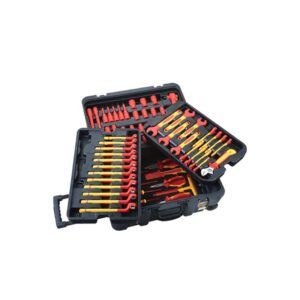
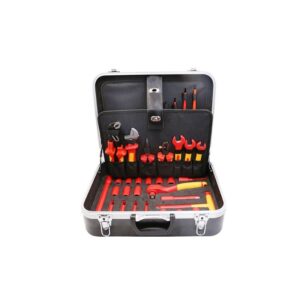
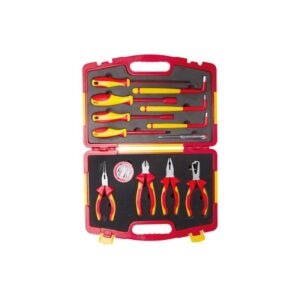
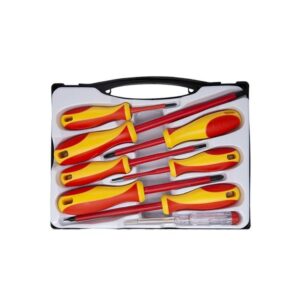
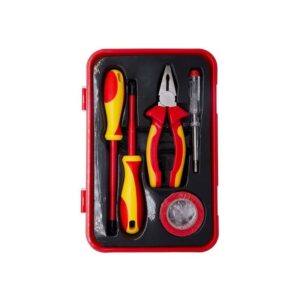
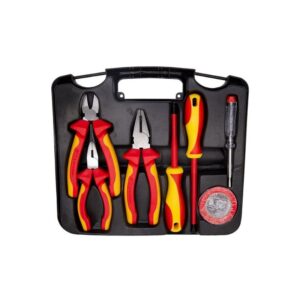
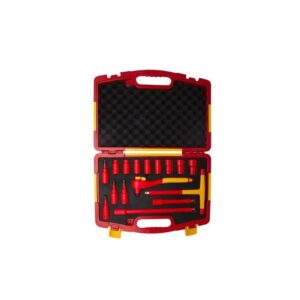
Tools sets insulated tools refers to collections of hand tools designed with electrical insulation, rated for high-voltage safety. These sets—often labelled “VDE 1000 V”—include insulated screwdrivers, pliers, wrenches, socket spanners, and accessories tested to standards such as IEC 60900 for protection from electric shock. Industrial electricians, power utility technicians, and maintenance engineers seek these for safe work on live electrical systems and installations.
This category includes multi-tool sets ranging from compact kits with five to eight insulated screwdrivers and a voltage tester, up to full suites with dozens of components—42-piece and 68-piece tool sets. There are also socket spanner sets insulated for VDE 1000 V use. Each item is composed of tools like insulated pliers, diagonal cutters, hex keys, adjustable wrenches, Phillips-and slotted-head screwdrivers, and those used with ratchets and sockets. All are designed for use where electrical insulation is mandatory.
Insulated tool sets are used primarily in power generation, transmission, and distribution environments where risks of electrical shock are present. They serve in routine maintenance of switchgear, installation of high voltage panels, and work on live circuits. Examples include “electrical safety tools” and “VDE-certified hand tools”. These sets support both preventative safety compliance and operational integrity in industrial plants or utility networks.
Insulated tool sets are designed such that all exposed metal parts are safely segregated from user contact by insulation material able to sustain specified voltage. Typical materials include PVC or similar dielectric coatings, often rated for 1000 volts AC under VDE or IEC 60900 standards. Usage entails technical characteristics such as tool hardness, torque ratings, insulation resistance, length, and size ranges. For example, hardened chrome-vanadium steel may be used for wrench jaws, while insulated handles must include full cover with flanges to prevent slippage. These sets often include sockets and spanners of varying metric and imperial dimensions—open-end wrenches, box ring wrenches, ratchets, extension bars—as well as screwdrivers with slotted and Phillips heads. Variation among sets is typically in quantity of pieces, type of tools included, and size range; some are compact 5-piece kits, others comprehensive 68-piece assortments. Compliance with standards and certifications (IEC 60900, VDE, GS, CE-marking) is common. Key selection considerations for professionals include the operating voltage requirement, size and types of fasteners worked on, environmental conditions (temperature, moisture), and required clearance or tool dimensions.
MEMIDOS serves as a global B2B platform connecting industrial buyers with verified manufacturers and suppliers of insulated tool sets. Buyers can purchase directly without intermediaries, which aids in reducing procurement overhead and securing more efficient procurement costs. Payment is handled via secure escrow: funds are held until order conditions such as shipment are fulfilled, ensuring both buyer protection and supplier reliability. Industrial procurement professionals benefit from access to high-quality, certified insulated tools backed by transparency in specifications and sourcing, supporting international projects and safety compliance across markets.
English
Български (Bulgarian)
Hrvatski (Croatian)
Čeština (Czech)
Dansk (Danish)
Nederlands (Dutch)
Suomi (Finnish)
Français (French)
Deutsch (German)
Ελληνικά (Greek)
Magyar (Hungarian)
Italiano (Italian)
Norsk bokmål (Norwegian Bokmål)
Polski (Polish)
Português (Portuguese (Portugal))
Română (Romanian)
Русский (Russian)
Español (Spanish)
Svenska (Swedish)
Türkçe (Turkish)