
Cart
No products in the cart.
 English
 Български (Bulgarian)
 Hrvatski (Croatian)
 Čeština (Czech)
 Dansk (Danish)
 Nederlands (Dutch)
 Suomi (Finnish)
 Français (French)
 Deutsch (German)
 Ελληνικά (Greek)
 Magyar (Hungarian)
 Italiano (Italian)
 Norsk bokmål (Norwegian Bokmål)
 Polski (Polish)
 Português (Portuguese (Portugal))
 Română (Romanian)
 Русский (Russian)
 Español (Spanish)
 Svenska (Swedish)
 Türkçe (Turkish)
Showing all 6 resultsSorted by popularity
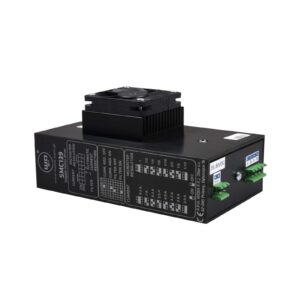
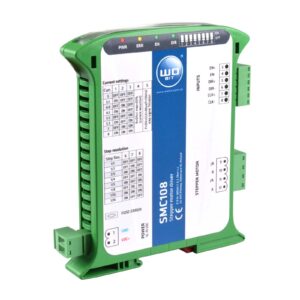
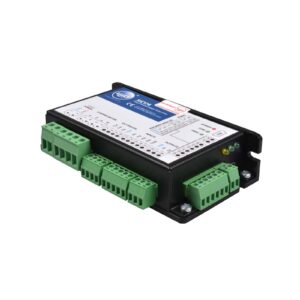
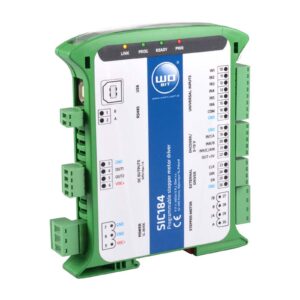
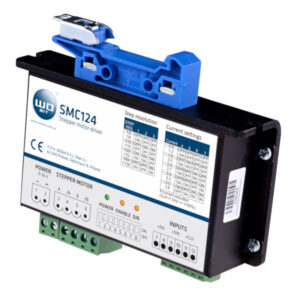
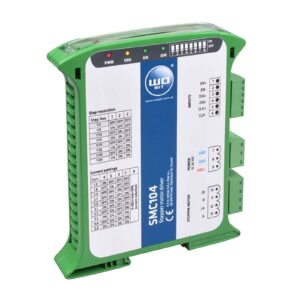
Stepper motor controllers are electronic devices used to manage and regulate the operation of stepper motors in industrial automation and motion control systems. These controllers translate control signals into precise step sequences, governing current, stepping resolution, and direction. They commonly involve features like microstepping, motor phase current regulation, supply voltage considerations, and indexers, and professionals seek components that ensure accurate motion control and integration with machinery.
This category features stepper motor controllers with a range of capabilities. You’ll see high-voltage controllers supporting up to 75 VDC, along with lower-voltage models around 36 VDC. Current ratings span from approximately 3-4 A up to about 8 A per phase. Step resolution options vary widely, including fine microstepping such as 1/64 and 1/128 steps. Also included are programmable controllers with built-in indexers for motion control tasks and ones optimized for specific wiring configurations like bipolar or unipolar windings. Cooling solutions include both passive heatsinks and fan-cooled housings.
Stepper motor controllers are used in industries such as robotics, CNC machining, packaging, and textile manufacturing where precise positional control and motion repeatability are essential. They are used for motion control, microstepping drive applications, and phase current regulation. These controllers suit tasks like driving linear actuators, rotary stages, conveyor systems, or automated labeling machines. They help maintain torque at various speeds, reduce vibration, and allow accurate speed control, especially in situations requiring high stepping resolution or programmable indexing.
Stepper motor controllers are designed to provide controlled electrical power to stepper motors, converting digital control signals (including step, direction, and enable) into phase outputs that drive motor windings. Key technical characteristics include supply voltage ranges (e.g. 36-75 VDC), phase current ratings (typically 3-8 A per phase), and step resolution options (from full step to microsteps such as 1/64 or 1/128). Thermal management is important—controllers may use metal housings with heatsinks or active cooling via fans. Variations include programmable units with indexer support, fixed microstep controllers, and models built for different winding types such as bipolar or unipolar.
Performance parameters to consider include PWM or chopping frequency, signal input levels and isolation (e.g. opto-isolated inputs), and current decay modes (mixed vs. slow or fast decay). Environmental factors like operating temperature range, IP rating (e.g. IP20), and mounting style (such as DIN-rail) also play a role. Compliance may require CE marking or similar certifications depending on region. Selection depends on compatibility with motor winding, required torque and speed, resolution needed for the application, and control signal protocol.
MEMIDOS offers access to stepper motor controllers via a global B2B platform where industrial buyers can source directly from manufacturers and verified suppliers without intermediaries. The absence of middlemen helps streamline procurement and often results in more competitive pricing. Payments are handled securely using an escrow-based system: funds are held until shipment or agreed-upon order conditions are satisfied, protecting both buyer and supplier. Verified suppliers contribute a transparent sourcing environment, making it simpler for buyers to assess product specifications and origin, which supports reliable international purchasing.
English
Български (Bulgarian)
Hrvatski (Croatian)
Čeština (Czech)
Dansk (Danish)
Nederlands (Dutch)
Suomi (Finnish)
Français (French)
Deutsch (German)
Ελληνικά (Greek)
Magyar (Hungarian)
Italiano (Italian)
Norsk bokmål (Norwegian Bokmål)
Polski (Polish)
Português (Portuguese (Portugal))
Română (Romanian)
Русский (Russian)
Español (Spanish)
Svenska (Swedish)
Türkçe (Turkish)