
Cart
No products in the cart.
 English
 Български (Bulgarian)
 Hrvatski (Croatian)
 Čeština (Czech)
 Dansk (Danish)
 Nederlands (Dutch)
 Suomi (Finnish)
 Français (French)
 Deutsch (German)
 Ελληνικά (Greek)
 Magyar (Hungarian)
 Italiano (Italian)
 Norsk bokmål (Norwegian Bokmål)
 Polski (Polish)
 Português (Portuguese (Portugal))
 Română (Romanian)
 Русский (Russian)
 Español (Spanish)
 Svenska (Swedish)
 Türkçe (Turkish)
Showing all 4 resultsSorted by popularity
Knives and scrapers ‒ brass refers to a category of hand tools featuring blades or edges made of brass, designed for scraping, spreading, or smoothing surfaces. These tools are non-magnetic and corrosion-resistant, often paired with handles made of materials like bakelite or wood. Industrial engineers, painters, coatings specialists, and metalworking professionals frequently search for brass knives and scrapers when they need tools that avoid sparking and provide compatibility with sensitive surface finishes.
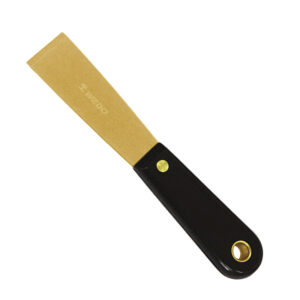
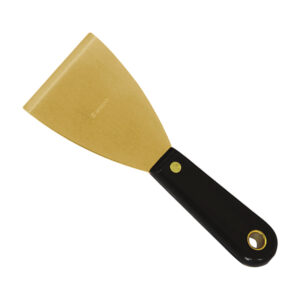
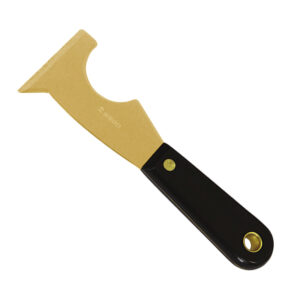
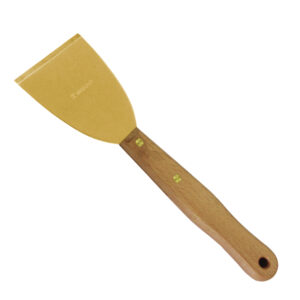
On this page, you will discover brass knives and scrapers including several types of putty knives. There is a multi-purpose putty knife with a bakelite handle, a narrow-blade version with a bakelite grip, a variant with a long wooden handle, and a standard brass putty knife also with a bakelite handle. These tools all share brass blades and are differentiated by handle style and blade width, suiting specific tasks such as precision scraping or applying filler over larger areas. Each product is crafted to balance strength and adaptability in surface preparation and finishing work.
Knives and scrapers made of brass are widely used in surface preparation, maintenance, and finishing processes. In paint and coatings industries, the tools help in spreading putty, removing adhesives or old coatings, and cleaning metal or plaster surfaces. In maintenance environments where non-sparking tools are required, such as chemical plants or oil refineries, brass putty knives are useful for safety compliance. Procurement professionals often specify non-sparking hand tools and surface preparation tools when sourcing blades suitable for industrial hygiene or safety-sensitive zones.
Brass knives and scrapers are primarily designed to perform functions such as spreading compound, scraping residue, smoothing surfaces, or removing material without damaging substrates. The blade material—brass—is chosen for its non-ferrous properties, providing resistance to corrosion, being non-magnetic, and offering safer operation in environments where sparks must be avoided.
Key technical characteristics include blade hardness, which—for the products listed—ranges around HRC 8–12, indicating relatively soft brass capable of slight deformation without brittle failure. Blade width and thickness are variable features: narrow blades allow precision work in tight spaces, while wider styles with longer handles are suited for larger surface coverage. Handles are made either of bakelite, for chemical resistance and gripping comfort, or wood, for increased reach and leverage.
Common variations within the category arise from handle material (bakelite vs wooden), blade shape (wide vs narrow), and overall tool size. Functionally, these differences affect reach, control, and suitability for specific tasks such as filling joints, scraping old coatings, or applying putty. In terms of standards or certifications, tools of this type may conform to general hand tool safety norms, such as non-sparking tool requirements or metallurgical specifications for non-ferrous metals; for example, compliance with hardness ratings and safe material selection is often referenced.
Selection considerations for industrial buyers include operating environment (for instance explosion risk zones may demand strictly non-sparking brass tools), compatibility with the surfaces being worked (softer brass avoids scratching delicate finishes), handle ergonomics for repetitive use, and required reach or blade size. Operating conditions such as temperature, exposure to chemicals, or regulations around non-magnetic tools should also guide the choice.
MEMIDOS is a global B2B platform that connects industrial buyers directly with verified manufacturers and suppliers, removing intermediaries. This structure helps ensure procurement is more efficient and cost-competitive. Payments are processed through secure escrow: funds are held by MEMIDOS and released only after order conditions such as shipment are met. For procurement professionals in industries like manufacturing, coatings, maintenance, or safety-sensitive operations, MEMIDOS offers access to high-quality brass knives and scrapers from trusted sources, simplifying international sourcing and enhancing transparency in tool selection and supply chain performance.
English
Български (Bulgarian)
Hrvatski (Croatian)
Čeština (Czech)
Dansk (Danish)
Nederlands (Dutch)
Suomi (Finnish)
Français (French)
Deutsch (German)
Ελληνικά (Greek)
Magyar (Hungarian)
Italiano (Italian)
Norsk bokmål (Norwegian Bokmål)
Polski (Polish)
Português (Portuguese (Portugal))
Română (Romanian)
Русский (Russian)
Español (Spanish)
Svenska (Swedish)
Türkçe (Turkish)