
Cart
No products in the cart.
 English
 Български (Bulgarian)
 Hrvatski (Croatian)
 Čeština (Czech)
 Dansk (Danish)
 Nederlands (Dutch)
 Suomi (Finnish)
 Français (French)
 Deutsch (German)
 Ελληνικά (Greek)
 Magyar (Hungarian)
 Italiano (Italian)
 Norsk bokmål (Norwegian Bokmål)
 Polski (Polish)
 Português (Portuguese (Portugal))
 Română (Romanian)
 Русский (Russian)
 Español (Spanish)
 Svenska (Swedish)
 Türkçe (Turkish)
Showing all 5 resultsSorted by popularity
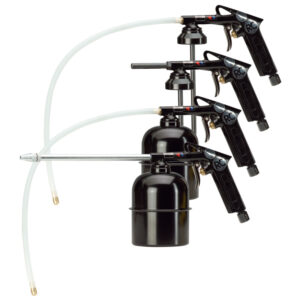
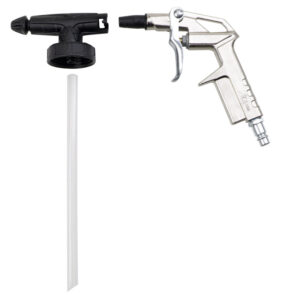
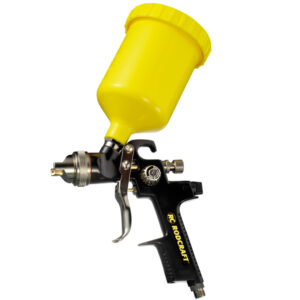
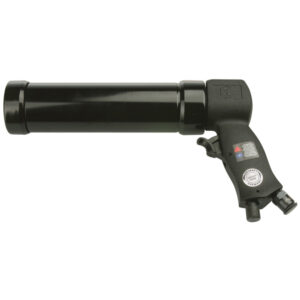
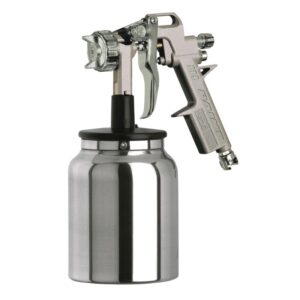
Spray guns (air / pneumatic) are tools that use compressed air or pneumatic pressure to atomize and apply coatings like paint, underbody protection, cleaning agents, and surface finishes. In industrial settings, these air-driven spray guns provide controlled flow, adjustable spray patterns, and efficient coverage for tasks such as painting, sealing, and cleaning. They are available in variants such as air spray guns, underbody protection spray guns, pneumatic spray systems, and other industrial finishing tools.
This category features pneumatic spray guns designed for various industrial applications. There are air spray guns with fluid containers (such as 1 L containers) and screw-thread connections. Some include multiple nozzles and extensions for flexible use. Other types include 4-in-1 spray guns suited for underbody protection, cavity sealing, or cleaning agents. Also present are wash-down guns or water spray guns built to withstand hot or cold water, certain pressure and temperature ratings, and materials that can handle harsh environments.
Air/pneumatic spray guns are used in automotive bodywork for coatings, underbody protection, sealing cavities, and applying cleaning agents. In manufacturing or fabrication workshops, they deliver finishes on metal surfaces or prepare parts for assembly. Water spray guns or wash-down variants are used in facility maintenance, food processing, or commercial kitchens for cleaning tasks, using cold or hot water under controlled pressure. Typical components and variants include spray nozzles, pneumatic coating tools, and hot-water-capable spray guns.
Air/pneumatic spray guns are tools that atomize liquids by forcing them through a nozzle using compressed air. Key technical characteristics include nozzle diameter (affecting droplet size and spray pattern), air inlet thread type (such as BSP ¼-inch), working pressure (bar or PSI), fluid container capacity, and material of construction (aluminum, brass, or rubber components for durability and temperature resistance). Wash-down guns specify maximum water pressure (e.g. 12-25 bar), flow rate (litres per minute), and maximum water temperature (e.g. up to 90 °C) to ensure safe operation. There are variations such as standard spray guns with containers, heavy-duty underbody protection guns, and wash-down water guns. Compliance with standards like CE marking, correct thread dimensions, material suitability, and pressure ratings are particularly relevant. Selection considerations include ambient temperature, type of fluid (paints, cleaning agents, water), required flow rate, nozzle compatibility, and whether spray gun materials resist corrosion or heat.
MEMIDOS is a global B2B platform connecting industrial buyers and engineers with verified manufacturers and suppliers. By purchasing directly from sources without intermediaries, buyers achieve more efficient procurement and access competitive pricing. All transactions are secured by an escrow-based payment system, ensuring funds are held by MEMIDOS until order conditions, such as shipment, are met. Verified suppliers and product listings increase transparency, simplifying the process of sourcing high-quality industrial spray guns across borders.
English
Български (Bulgarian)
Hrvatski (Croatian)
Čeština (Czech)
Dansk (Danish)
Nederlands (Dutch)
Suomi (Finnish)
Français (French)
Deutsch (German)
Ελληνικά (Greek)
Magyar (Hungarian)
Italiano (Italian)
Norsk bokmål (Norwegian Bokmål)
Polski (Polish)
Português (Portuguese (Portugal))
Română (Romanian)
Русский (Russian)
Español (Spanish)
Svenska (Swedish)
Türkçe (Turkish)