
Cart
No products in the cart.
 English
 Български (Bulgarian)
 Hrvatski (Croatian)
 Čeština (Czech)
 Dansk (Danish)
 Nederlands (Dutch)
 Suomi (Finnish)
 Français (French)
 Deutsch (German)
 Ελληνικά (Greek)
 Magyar (Hungarian)
 Italiano (Italian)
 Norsk bokmål (Norwegian Bokmål)
 Polski (Polish)
 Português (Portuguese (Portugal))
 Română (Romanian)
 Русский (Russian)
 Español (Spanish)
 Svenska (Swedish)
 Türkçe (Turkish)
Showing all 4 resultsSorted by popularity
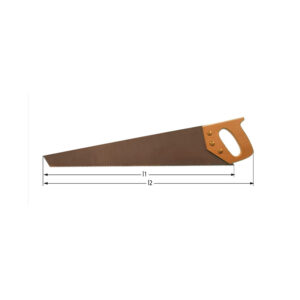
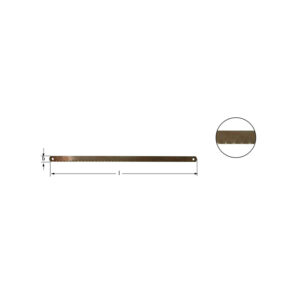
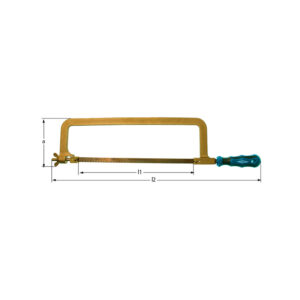
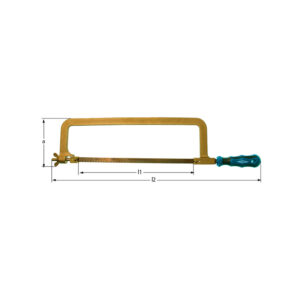
Saws - Non-sparking refers to cutting tools designed to operate without generating sparks or producing magnetic reactions, using materials like beryllium copper or aluminum bronze. These saws are crafted for environments with flammable gases, dust, or explosive atmospheres. Examples include non-sparking saws, non-magnetic saw blades, beryllium copper tools, and aluminum bronze hacksaws.
In this category you’ll encounter non-sparking hand saws and hacksaws composed of specialized alloys. Types include a hand saw with wooden handle featuring 8 teeth per inch made in beryllium copper, a saw blade for hacksaw in beryllium copper, and full hacksaws available in both beryllium copper and aluminum bronze alloys. These items are crafted to deliver safe cutting performance in hazardous or sensitive industrial settings.
Non-sparking saws are employed in industries such as petrochemical, oil & gas, mining, food processing, and munitions manufacturing, where prevention of ignition is critical. They are used for cutting metal pipes, trimming flanges, maintenance tasks on explosive gas pipelines, and repair work in locations with volatile atmospheres. They are considered intrinsic safety tools and explosion-proof cutting equipment and are available in non-magnetic designs.
Saws in this category are hand-operated cutting tools engineered to function in environments that demand spark safety and zero magnetic interference. Primary materials are beryllium copper (BeCu) and aluminum bronze (AlBz). Performance parameters include teeth per inch (TPI) for hand saws (e.g. 8 TPI), blade hardness balanced against toughness to resist brittle failure, and non-magnetic material properties. Dimensional standards involve blade length, tooth pitch, frame geometry for hacksaws, and handle ergonomics with non-sparking fixtures. Compliance considerations may include ATEX or IECEx for explosive atmospheres, and material quality standards for alloy composition and heat treatment. Variations include full handsaws, blade-only for frames, and hacksaw assemblies with frames compatible with different blade materials. Selection factors include ambient temperature, corrosive exposure, spark potential, blade fatigue resistance, and compatibility with cutting frames or blade holders.
MEMIDOS is a global B2B platform for industrial products, offering direct access to manufacturers and suppliers without intermediaries. By eliminating middle men, procurement is more efficient and pricing more transparent. Payments are handled securely via an escrow-based system where funds are held until delivery conditions such as shipment are fulfilled, safeguarding buyers and supporting supplier reliability. Buyers gain access to high-quality industrial tools from verified suppliers worldwide. MEMIDOS simplifies international sourcing by improving transparency and providing a platform structured for professional industrial procurement.
English
Български (Bulgarian)
Hrvatski (Croatian)
Čeština (Czech)
Dansk (Danish)
Nederlands (Dutch)
Suomi (Finnish)
Français (French)
Deutsch (German)
Ελληνικά (Greek)
Magyar (Hungarian)
Italiano (Italian)
Norsk bokmål (Norwegian Bokmål)
Polski (Polish)
Português (Portuguese (Portugal))
Română (Romanian)
Русский (Russian)
Español (Spanish)
Svenska (Swedish)
Türkçe (Turkish)