
Cart
No products in the cart.
 English
 Български (Bulgarian)
 Hrvatski (Croatian)
 Čeština (Czech)
 Dansk (Danish)
 Nederlands (Dutch)
 Suomi (Finnish)
 Français (French)
 Deutsch (German)
 Ελληνικά (Greek)
 Magyar (Hungarian)
 Italiano (Italian)
 Norsk bokmål (Norwegian Bokmål)
 Polski (Polish)
 Português (Portuguese (Portugal))
 Română (Romanian)
 Русский (Russian)
 Español (Spanish)
 Svenska (Swedish)
 Türkçe (Turkish)
Showing all 2 resultsSorted by popularity
Workshop mobility equipment refers to tools designed to assist movement, positioning, and access inside automotive repair shops and industrial workspaces. Such equipment includes rolling boards, roller seats, and mobility platforms that help technicians work comfortably under vehicles, access low-height areas, and transport small components. Intended for industrial buyers seeking high quality workshop tools, this category supports efficiency in workshops, garage tool rooms, and service bays.
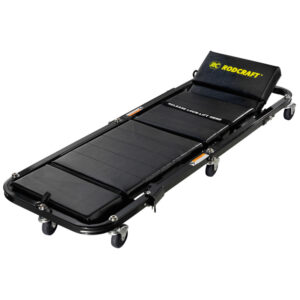
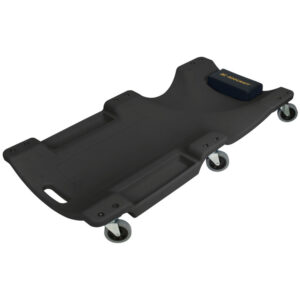
This category contains workshop roller boards and roller platforms crafted for mobility in constrained workspaces. One product allows dual use as a bench and stool with adjustable height; another model offers a low-profile design with minimal clearance—around 15 mm—with several swivel castors. Both are built to support substantial load capacity, suitable for technicians working under vehicles or in low overhead spaces. These are the primary tools explicitly shown here.
These mobility platforms find application in automotive maintenance, chassis and undercarriage inspection, and assembly tasks that require close-quarters access. Common product types include roller boards, rolling stools, and low-profile rolling platforms. Industries using them include automotive repair shops, fleet maintenance garages, body shops, and heavy equipment services needing ergonomic access beneath vehicles or elevated machinery.
Workshop mobility equipment is fundamentally a low-profile platform or board mounted on swivel castors to enable movement across shop floors while supporting the weight of both technician and tools. Key technical characteristics include load capacity (e.g. up to 90 kg), platform height (from around 15 mm to adjustable heights), number and type of castors (swivel functionality, material resistance to oils and chemicals), and structural rigidity—steel or composite materials capable of resisting deformation. Tolerances for flatness and alignment are critical when accessing areas under vehicles; deviations can hamper performance or safety.
Typical variations include fixed-height roller boards versus 2-in-1 designs that convert between stool and bench functions. Low-profile types offer minimal clearance ideal for tight spaces; taller or adjustable versions enhance operator comfort. Material selection often involves steel frames with anti-corrosive finish or composite decks with non-slip surfaces. Relevant standards may include CE marking for safety, load rating compliance, and caster durability testing. Buyers must consider operating environment (temperature, exposure to fluids), floor surface compatibility (smoothness, cleanliness), weight loading and frequency of use to ensure the platform’s performance and lifespan.
MEMIDOS operates as a global B2B industrial platform connecting buyers and manufacturers directly. With no intermediaries, procurement becomes more efficient and pricing more transparent. Transactions are secured through escrow-based payment handling, where funds are released only once shipment or agreed order conditions are fulfilled, offering protection for buyers and reliability for suppliers. All products are sourced from verified industrial suppliers, ensuring quality of manufacturing and conformity to relevant industrial standards. MEMIDOS simplifies international procurement by providing clear product specifications, trusted suppliers, and improved visibility into sourcing and production.
English
Български (Bulgarian)
Hrvatski (Croatian)
Čeština (Czech)
Dansk (Danish)
Nederlands (Dutch)
Suomi (Finnish)
Français (French)
Deutsch (German)
Ελληνικά (Greek)
Magyar (Hungarian)
Italiano (Italian)
Norsk bokmål (Norwegian Bokmål)
Polski (Polish)
Português (Portuguese (Portugal))
Română (Romanian)
Русский (Russian)
Español (Spanish)
Svenska (Swedish)
Türkçe (Turkish)