
Cart
No products in the cart.
 English
 Български (Bulgarian)
 Hrvatski (Croatian)
 Čeština (Czech)
 Dansk (Danish)
 Nederlands (Dutch)
 Suomi (Finnish)
 Français (French)
 Deutsch (German)
 Ελληνικά (Greek)
 Magyar (Hungarian)
 Italiano (Italian)
 Norsk bokmål (Norwegian Bokmål)
 Polski (Polish)
 Português (Portuguese (Portugal))
 Română (Romanian)
 Русский (Russian)
 Español (Spanish)
 Svenska (Swedish)
 Türkçe (Turkish)
Showing all 7 resultsSorted by popularity
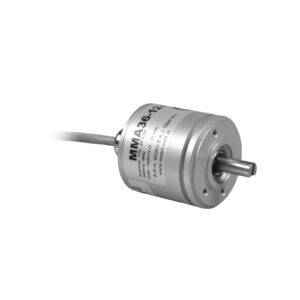
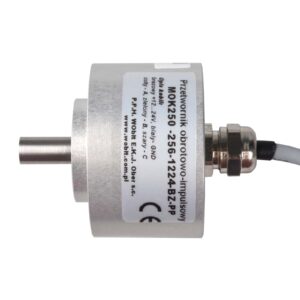
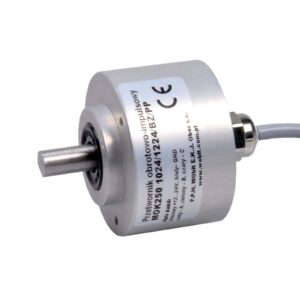
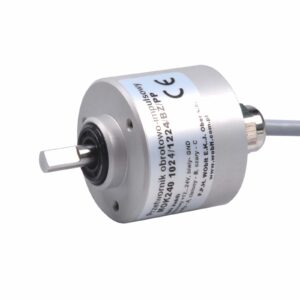
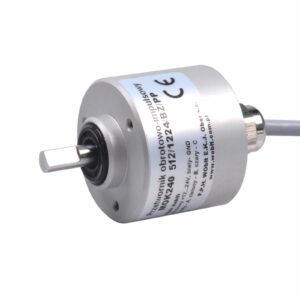
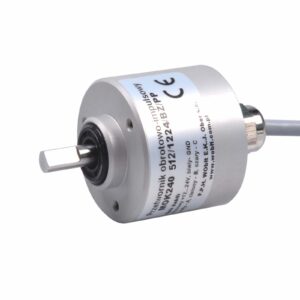
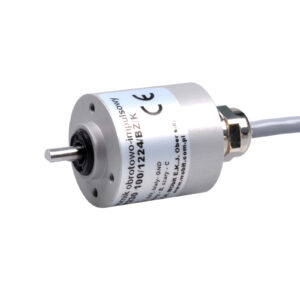
Encoders are sensor devices that convert mechanical motion—usually rotation or movement—into electronic signals. They enable measurement of position, speed, angle, or distance in industrial systems. They are commonly specified for motion-control components and feedback devices.
This category includes absolute encoders and incremental magnetic encoders. The absolute encoder offers outputs such as a 4-20 mA current signal, providing precise absolute position information even after power loss. The incremental magnetic encoders produce pulses—examples include models with 100, 256, 512 or 1024 pulses per revolution—which are suited to detecting motion, counting steps, or measuring velocity. All products listed belong to the rotary encoder type rather than linear or non‐rotary variants.
Encoders are applied in motion control systems, robotic arms, conveyor systems, and automated machinery where accurate position or speed feedback is essential. Absolute encoders are used where knowing the exact position on power up is required, for example in safety systems or when initialization must be avoided. Incremental magnetic encoders are useful for monitoring rotations and speed or for tracking incremental movement in packaging, assembly, or printing machines. Important technical considerations include encoder resolution, feedback interfaces, and pulses per revolution.
Encoders are feedback devices that detect rotational angle or angular displacement and convert it into an electrical output. Key technical characteristics include output type (absolute vs. incremental), signal interface (current output like 4-20 mA in absolute encoders; pulses per revolution in incremental ones), and resolution (e.g. 12-bit absolute yielding 4096 steps or impulse counts like 256, 512, 1024 pulses for incremental). Housing material (such as aluminum), housing protection rating (e.g. IP50), shaft material (for example stainless steel) and bearing type (often double ball bearings) influence mechanical durability. Environmental parameters like operating temperature range (for example -25 °C to +55 °C) also matter. Typical variations include magnetic encoders—offering resistance to dust and drift—and optical types (not shown in this range). Standards or certifications such as CE marking are relevant for compliance. Selection considerations include the needed resolution, required output type, environmental conditions (temperature, exposure, protection class), rotational speed, and compatibility with control system inputs.
MEMIDOS is a global B2B platform offering industrial products directly from verified manufacturers and suppliers. By removing intermediaries, procurement is more efficient and pricing more competitive. Payments are handled through a secure escrow system, where funds are held by MEMIDOS until order conditions—such as shipment—are met, offering protection and reliability to both buyers and suppliers. The platform simplifies international sourcing and ensures greater transparency for professionals seeking industrial-grade encoders and technical components.
English
Български (Bulgarian)
Hrvatski (Croatian)
Čeština (Czech)
Dansk (Danish)
Nederlands (Dutch)
Suomi (Finnish)
Français (French)
Deutsch (German)
Ελληνικά (Greek)
Magyar (Hungarian)
Italiano (Italian)
Norsk bokmål (Norwegian Bokmål)
Polski (Polish)
Português (Portuguese (Portugal))
Română (Romanian)
Русский (Russian)
Español (Spanish)
Svenska (Swedish)
Türkçe (Turkish)