
Cart
No products in the cart.
 English
 Български (Bulgarian)
 Hrvatski (Croatian)
 Čeština (Czech)
 Dansk (Danish)
 Nederlands (Dutch)
 Suomi (Finnish)
 Français (French)
 Deutsch (German)
 Ελληνικά (Greek)
 Magyar (Hungarian)
 Italiano (Italian)
 Norsk bokmål (Norwegian Bokmål)
 Polski (Polish)
 Português (Portuguese (Portugal))
 Română (Romanian)
 Русский (Russian)
 Español (Spanish)
 Svenska (Swedish)
 Türkçe (Turkish)
Showing all 14 resultsSorted by popularity
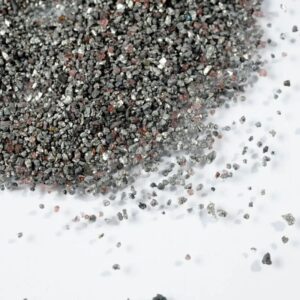
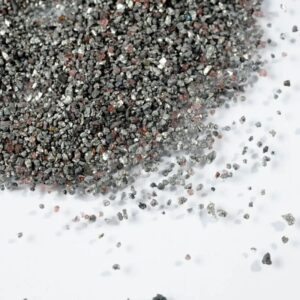
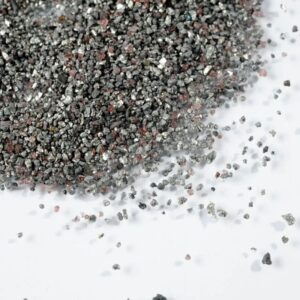
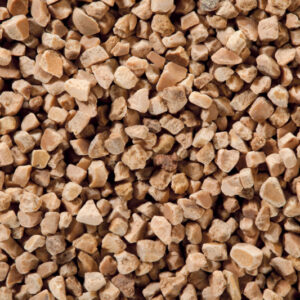









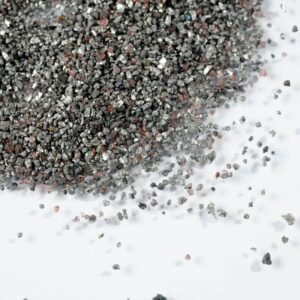
Blasting material for sandblasting refers to granular media used in abrasive blasting processes to clean, finish, or prepare surfaces by forcefully propelling the media over substrates. Common descriptors include media type, particle size, and intended surface finish. These materials are selected based on hardness, abrasiveness, and suitability for metal, glass, wood, or delicate parts to meet high-quality industrial performance.
This category includes abrasive media such as aluminium oxide in various grain size ranges (for example, 0.12-0.25 mm, 0.25-0.50 mm, 0.50-1.00 mm) and glass beads offered in multiple micron grades (such as 40-70 µm, 70-110 µm, 90-150 µm, 100-200 µm, 150-250 µm, 200-300 µm, 400-600 µm, 600-800 µm). Also available are walnut shell granules of medium grain size. All products are supplied in bulk bags weighing approximately 25 kg.
Blasting materials in this category are used in surface treatment operations for industrial sectors such as automotive, fabrication, restoration, and maintenance. Aluminium oxide media is preferred for aggressive cleaning, deburring, scaling, and etching on metals, glass, and wood. Glass beads are used for peening, polishing, refining delicate surfaces, casting parts, and restoring finishes without aggressive wear. Walnut shell granules are used where gentle abrasive cleaning is needed, such as for electronic components, soft surfaces, or finishing tasks that require preservation of underlying geometry. Important considerations include surface preparation and abrasive grain specification.
Blasting material for sandblasting consists of solid particulate media characterised by material hardness, grain or particle size, shape, and chemical composition. Materials such as aluminium oxide and glass beads differ in hardness, fracturing behavior, and surface impact. Grain sizes are measured in millimetres or micrometres; finer grades (tens of micrometres) yield smoother finishes, whereas coarse ranges (hundreds of micrometres) are used for heavy duty stripping.
Aluminium oxide is a hard, angular abrasive with high cutting power; it delivers aggressive removal of paint, scale or rust and a textured finish for coatings to adhere. Glass beads are spherical, softer, and chemically inert, thus suited for finishing or peening tasks. Walnut shell granules are organic, biodegradable, and provide the least surface damage among these types, used for lighter cleaning.
Relevant technical parameters include hardness (Mohs scale or equivalent), grain size tolerance, particle shape, dust content, silica-free or low-silica composition, iron content (low-iron to avoid rust staining), recyclability, and weight per bag. Compliance features to consider include CE marking, safety data sheet (e.g. REACH), and workplace exposure limits to dust. Variations in media type (hard angular vs. spherical vs. organic) affect energy transferred per impact, surface profile, recovery of media, and equipment wear. Selection depends on substrate hardness, finish requirement, operating pressure, environment (wet vs. dry media), and potential chemical sensitivity of the part.
MEMIDOS operates as a global B2B platform specialising in industrial products. Buyers procure blasting materials directly from manufacturers and verified suppliers, eliminating intermediaries. This model enhances procurement efficiency and helps maintain competitive pricing. Payment transactions are secure and escrow-based: funds are held by the platform until order conditions such as confirmation of shipment are satisfied, protecting both buyer and supplier. The assortment includes high-quality industrial media with traceable specifications. MEMIDOS simplifies international sourcing by offering transparency of origin, material data, and regulatory compliance across borders.
English
Български (Bulgarian)
Hrvatski (Croatian)
Čeština (Czech)
Dansk (Danish)
Nederlands (Dutch)
Suomi (Finnish)
Français (French)
Deutsch (German)
Ελληνικά (Greek)
Magyar (Hungarian)
Italiano (Italian)
Norsk bokmål (Norwegian Bokmål)
Polski (Polish)
Português (Portuguese (Portugal))
Română (Romanian)
Русский (Russian)
Español (Spanish)
Svenska (Swedish)
Türkçe (Turkish)