
Cart
No products in the cart.
 English
 Български (Bulgarian)
 Hrvatski (Croatian)
 Čeština (Czech)
 Dansk (Danish)
 Nederlands (Dutch)
 Suomi (Finnish)
 Français (French)
 Deutsch (German)
 Ελληνικά (Greek)
 Magyar (Hungarian)
 Italiano (Italian)
 Norsk bokmål (Norwegian Bokmål)
 Polski (Polish)
 Português (Portuguese (Portugal))
 Română (Romanian)
 Русский (Russian)
 Español (Spanish)
 Svenska (Swedish)
 Türkçe (Turkish)
Showing all 3 resultsSorted by popularity
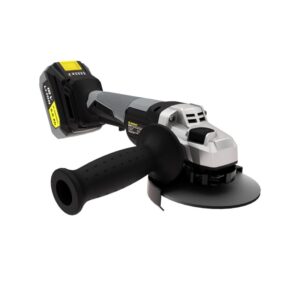
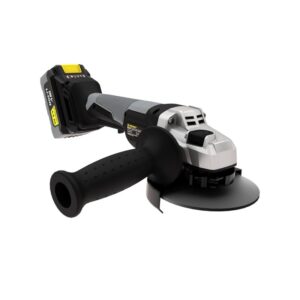
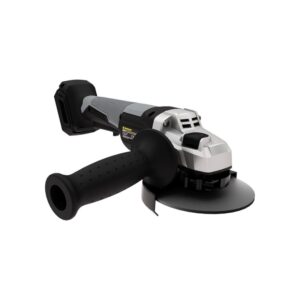
Battery grinders are cordless power tools designed for cutting, grinding, and polishing operations in industrial settings. These machines typically include an angle grinder version, with variations that may come as a standalone grinder or in a full set including battery and charger. Important specifications include disc diameter, RPM rating, battery voltage, and safety features that professionals use to evaluate tools.
This category on MEMIDOS includes cordless angle grinders in several configurations. There are sets that bundle the grinder with batteries and chargers, along with a carry case; single-unit tools without battery or charger for users who already have compatible systems; tools with differing battery capacities; and variations in accessories included. Each option is clearly specified with features like disc size, RPM, and whether components such as batteries or chargers are part of the package.
Battery grinders are used across fabrication, construction, metalworking, and masonry industries. They are employed for cutting steel or concrete, surface grinding, edge finishing, and welding prep. Typical applications include cordless angle grinding, abrasive disc operations, and cutting metal and stone. These tools are chosen for jobs requiring portability, damage control on site, and reduced dependency on mains power.
In industrial applications, battery grinders function as high-speed rotary tools that drive abrasive or cutting discs. Key parameters include disc diameter—125 mm is common in the visible range—rotational speed given in revolutions per minute (RPM), with 8,500 RPM shown in current models. Motors may be brushless for better efficiency and durability. Battery voltage and capacity are critical: models appear in different Ah ratings (for example, 4 Ah and 6 Ah), affecting run time and power output.
Performance characteristics also involve safety and operational design: features such as soft-start circuits, restart protection following power interruption, tool-free guards for safety and ease, and compatibility with standardized spindle or arbor threads (such as M14) are important. Variation between a bare tool (without battery/charger) versus a full kit with two batteries, a charger, and carry case affects system compatibility and resource planning.
Industrial standards or markings may apply—CE compliance and power tool safety directives are expected for products sold in regulated markets. Selection considerations should include the environment (for example, whether grinding sparks or dust are a concern), load demands (continuous vs intermittent use), availability of compatible battery systems, and duty cycle. Material compatibility of the discs—whether for stone, steel, or concrete—must match grinder specifications.
MEMIDOS operates as a global B2B platform focused on industrial equipment. When procuring battery grinders here, buyers interact directly with verified manufacturers and suppliers, eliminating intermediaries. This structure helps in streamlining procurement workflows and enhancing price efficiency without sacrificing reliability. Payments are escrow-based: funds are securely held by MEMIDOS until order conditions—such as shipment or delivery—are fulfilled, delivering protection to buyers while ensuring payment certainty for suppliers. Access is gained to industrial-grade battery grinders with transparent sourcing and technical detail, aiding procurement professionals in international operations and high-spec projects.
English
Български (Bulgarian)
Hrvatski (Croatian)
Čeština (Czech)
Dansk (Danish)
Nederlands (Dutch)
Suomi (Finnish)
Français (French)
Deutsch (German)
Ελληνικά (Greek)
Magyar (Hungarian)
Italiano (Italian)
Norsk bokmål (Norwegian Bokmål)
Polski (Polish)
Português (Portuguese (Portugal))
Română (Romanian)
Русский (Russian)
Español (Spanish)
Svenska (Swedish)
Türkçe (Turkish)