
Cart
No products in the cart.
 English
 Български (Bulgarian)
 Hrvatski (Croatian)
 Čeština (Czech)
 Dansk (Danish)
 Nederlands (Dutch)
 Suomi (Finnish)
 Français (French)
 Deutsch (German)
 Ελληνικά (Greek)
 Magyar (Hungarian)
 Italiano (Italian)
 Norsk bokmål (Norwegian Bokmål)
 Polski (Polish)
 Português (Portuguese (Portugal))
 Română (Romanian)
 Русский (Russian)
 Español (Spanish)
 Svenska (Swedish)
 Türkçe (Turkish)
Showing all 8 resultsSorted by popularity
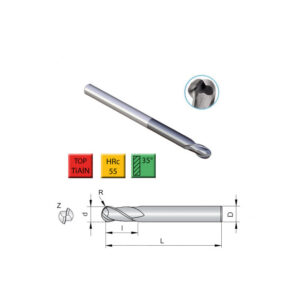
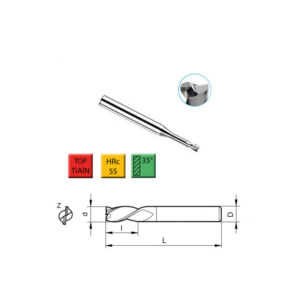
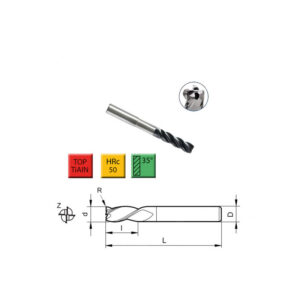
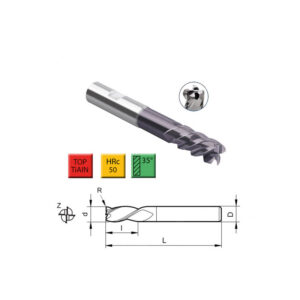
Milling cutters are precision cutting tools used in CNC milling, machining centres, and industrial milling machines for shaping a wide range of materials. These tools are essential for material removal, contouring, slotting, and edge finishing in metals including steel, stainless steel, and non-ferrous alloys. Professionals often seek high-quality carbide end mills or chamfering cutters with controlled geometry, hardness, and finish.
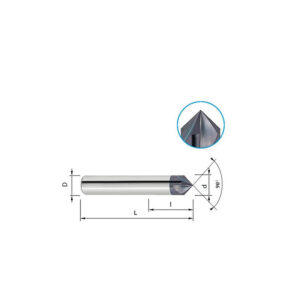
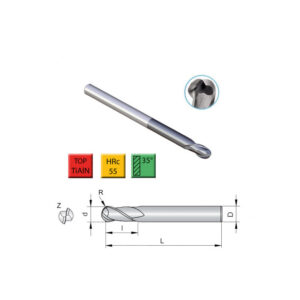
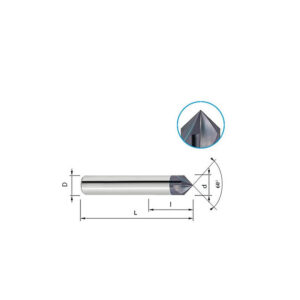
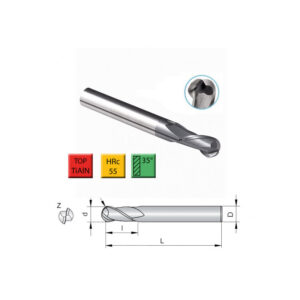
This category features milling cutters such as carbide milling cutters with two or four teeth in various diameter and cutting-length combinations, long versions of four-flute cutters for extended reach, and shank variants including those with 3 mm or 4 mm shanks. Also included are deburring chamfer cutters with fixed angles of 60° or 90°, available in tool diameters ranging from 4 mm up to 12 mm. All items are variants that allow you to select tool diameter, cutting length, shank diameter or chamfer angle according to machining needs.
These milling cutters are used in high-precision machining environments such as mould and die making, aerospace component manufacturing, and tooling for automotive parts. Carbide two-flute and four-flute cutters are suited for finishing, profiling, or slotting operations while maintaining tight tolerances. Deburring chamfer cutters are commonly used to clean up edges, prepare surfaces, and eliminate burrs after cutting or stamping operations. Surface finish and hardness rating are important to designers.
Milling cutters in this category are tools typically made from fine-grained universal carbide, often coated with TiAlN-based layers to provide high heat resistance and low friction. Key performance parameters include tool diameter, cutting length, shank diameter, number of teeth (flutes), corner radius, helix angle, and maximum material hardness (e.g. up to 55 HRc or 58 HRc depending on variant). Chamfer cutters are defined by their chamfer angle—60° or 90°—and number of cutting edges.
Functional variations include two-teeth end mills for small slots or fine detail work, four-teeth long version cutters for deep milling or extended reach, and chamfer cutters specifically for deburring or creating chamfered edges. Performance tolerances relate to deviations in diameter and run-out, particularly critical in high‐accuracy machining.
Materials compatibility is critical: these tools are designed for steels, stainless steels, non‐ferrous alloys, titanium alloys, nickel steels, and sometimes plastics—all depending on coating and hardness tolerance. Selection considerations include the operating environment (dry, high speed, high heat), load per tooth, coolant or lubrication conditions, required edge quality and finish, and machine spindle speed capability. Relevant industry standards include hardness scales (Rockwell HRc), coating hardness (microhardness in HV), and geometrical compliance (diameter, helix angle).
MEMIDOS is a global B2B platform specialising in industrial tooling and machine components. Procurement professionals can purchase milling cutters directly from manufacturers and verified suppliers without intermediaries, ensuring leaner supply chains and more precise product specification. Payments are managed securely through an escrow system: funds are held until order conditions, such as shipment, are fulfilled. Buyers benefit from transparent sourcing, access to certified high-quality products, and streamlined international procurement with reduced complexity and reliable adherence to spec.
English
Български (Bulgarian)
Hrvatski (Croatian)
Čeština (Czech)
Dansk (Danish)
Nederlands (Dutch)
Suomi (Finnish)
Français (French)
Deutsch (German)
Ελληνικά (Greek)
Magyar (Hungarian)
Italiano (Italian)
Norsk bokmål (Norwegian Bokmål)
Polski (Polish)
Português (Portuguese (Portugal))
Română (Romanian)
Русский (Russian)
Español (Spanish)
Svenska (Swedish)
Türkçe (Turkish)