
Cart
No products in the cart.
 English
 Български (Bulgarian)
 Hrvatski (Croatian)
 Čeština (Czech)
 Dansk (Danish)
 Nederlands (Dutch)
 Suomi (Finnish)
 Français (French)
 Deutsch (German)
 Ελληνικά (Greek)
 Magyar (Hungarian)
 Italiano (Italian)
 Norsk bokmål (Norwegian Bokmål)
 Polski (Polish)
 Português (Portuguese (Portugal))
 Română (Romanian)
 Русский (Russian)
 Español (Spanish)
 Svenska (Swedish)
 Türkçe (Turkish)
Showing all 11 resultsSorted by popularity
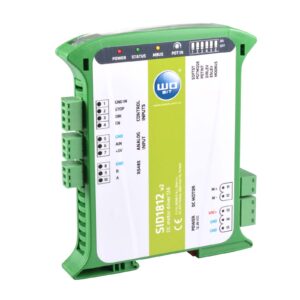
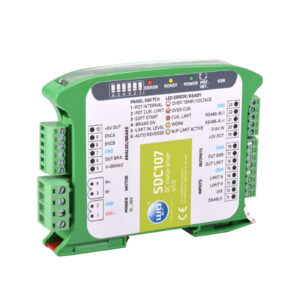
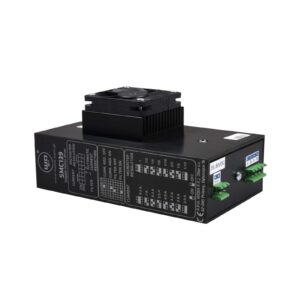
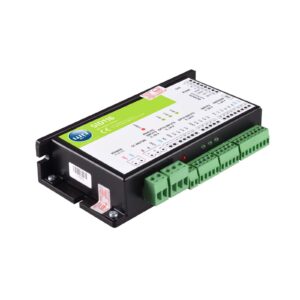
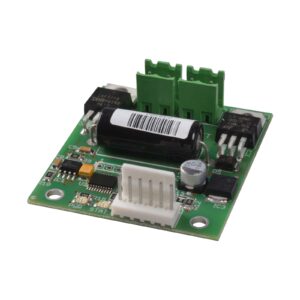
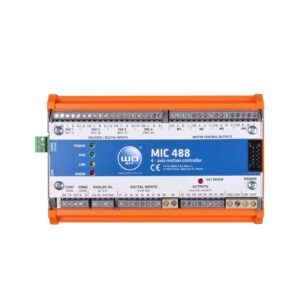
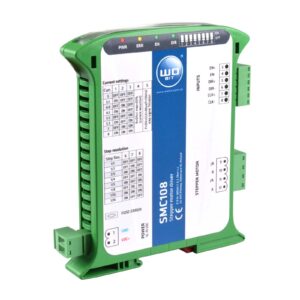
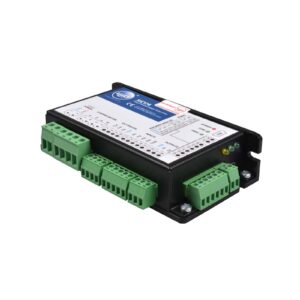
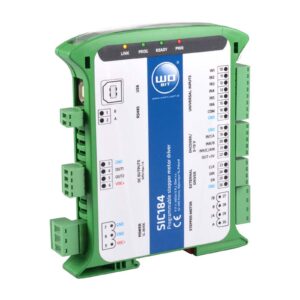
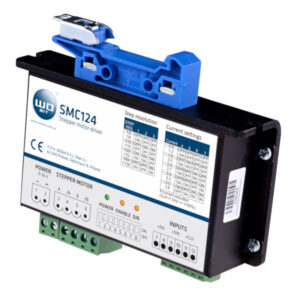
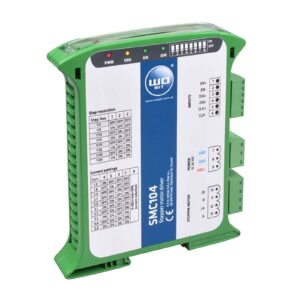
Motor controllers refer to industrial electrical devices used to manage and regulate the operation of motors. They control attributes such as torque, speed, direction, and positioning, optimizing performance in automation, robotics, and drive systems. They are used for speed control, torque regulation, motion control, DC and stepper motor interfaces, multi-axis coordination, load capacity, and precision control.
In this category, you will find several types of motor controllers designed for different control architectures. You can access DC motor controllers that provide control over direct current driven motors. There are stepper motor controllers suited for precision positioning and incremental movement. Also included are multi-axis controllers that coordinate multiple motor drives simultaneously. These controllers come with features such as programmable inputs and outputs, built-in indexers, and step resolution options for stepper systems.
These motor controllers are used in machine automation, robotics, and equipment where precise motion control is required. In material handling systems, automated assembly lines, and CNC machinery speed and direction control are essential. For positioning tasks in packaging equipment or laboratory robotics, stepper motor controllers offer precise step resolution. Multi-axis controllers enable synchronized operation of several actuators in conveyors, robotic arms, or complex motion platforms. They are commonly employed in motion control systems and for industrial drive regulation.
Motor controllers are devices that manage the electric power delivered to motors to control performance parameters such as torque, speed, and direction of rotation. Key technical characteristics include current rating (for example, 7 A, 12 A, 16 A in DC controllers), voltage rating (e.g., 36 VDC, 75 VDC), step resolution for stepper controllers (for example 1/16, 1/64, 1/128 steps), the presence of built-in indexers, and programmable I/O channels on multi-axis units. Typical use cases are applications requiring precise motion, such as positioning systems, robotics, or automation lines. Variations within this category include DC motor controllers, which directly drive DC motors; stepper motor controllers, which provide discrete step control; and multi-axis controllers, which can operate several motors in coordinated motion. Compliance considerations may include ensuring controllers meet electrical safety standards, EMC (electromagnetic compatibility) regulations, insulation ratings, thermal tolerances, and protection against overcurrent. Selection considerations include the load’s current and torque requirements, the operating environment (temperature, dust, moisture), compatibility with motor type, step resolution or feedback needs, voltage supply, and signal interface constraints.
MEMIDOS operates as a global B2B platform for industrial equipment, enabling direct purchases from manufacturers and suppliers without intermediaries. The absence of middle men helps streamline procurement and can result in more competitive pricing. Payment on MEMIDOS is handled via a secure escrow-based system, meaning that funds are held until the agreed order conditions, such as shipment, are satisfied. Buyers gain access to industrial-grade motor controllers from verified suppliers, enhancing quality assurance. MEMIDOS aims to simplify international sourcing and improve transparency throughout the procurement process.
English
Български (Bulgarian)
Hrvatski (Croatian)
Čeština (Czech)
Dansk (Danish)
Nederlands (Dutch)
Suomi (Finnish)
Français (French)
Deutsch (German)
Ελληνικά (Greek)
Magyar (Hungarian)
Italiano (Italian)
Norsk bokmål (Norwegian Bokmål)
Polski (Polish)
Português (Portuguese (Portugal))
Română (Romanian)
Русский (Russian)
Español (Spanish)
Svenska (Swedish)
Türkçe (Turkish)