
Cart
No products in the cart.
 English
 Български (Bulgarian)
 Hrvatski (Croatian)
 Čeština (Czech)
 Dansk (Danish)
 Nederlands (Dutch)
 Suomi (Finnish)
 Français (French)
 Deutsch (German)
 Ελληνικά (Greek)
 Magyar (Hungarian)
 Italiano (Italian)
 Norsk bokmål (Norwegian Bokmål)
 Polski (Polish)
 Português (Portuguese (Portugal))
 Română (Romanian)
 Русский (Russian)
 Español (Spanish)
 Svenska (Swedish)
 Türkçe (Turkish)
Showing all 5 resultsSorted by popularity
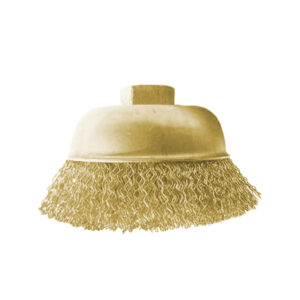
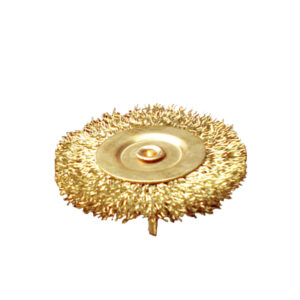
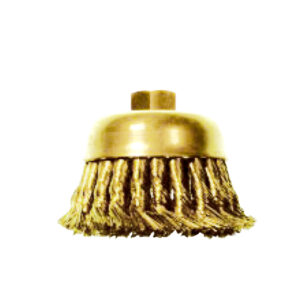

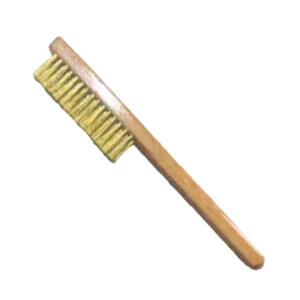
Wire brushes - Brass are hand tools featuring bristles or wire filaments made entirely or partly from brass, designed for cleaning, deburring, polishing, and surface preparation in industrial environments. Ideal for removing rust, paint overspray, weld scale, or oxidation without damaging base metals. Common product types include brass wire brush, brass bristle wheel brush, cup brush brass, and industrial wire brushes for metalwork.
The category contains various types of brass wire brushes suited for industrial surface treatment. Examples include a wheel brush with knoted brass wire, a standard wheel brush in brass, a cup brush with knot wire, a plain brass cup brush, and a general brass wire brush suitable for hand or power tool use. These products vary by mounting style—wheel or cup—wire configuration—smooth or knot—and scale of brush form, ranging from compact hand-held brushes to larger, tool-mounted wheels and cups designed for heavy-duty tasks.
Brass wire brushes are employed in applications where non-ferrous surfaces or sensitive metals require cleaning or finishing without scratching or sparking. In metalworking and fabrication shops, these tools remove oxidation, scale, or welding slag while preserving underlying material integrity. In maintenance and restoration tasks, especially on materials like brass, copper, bronze, or plated surfaces, the gentler brass bristles prevent surface damage. They are commonly used for surface preparation and as non-sparking wire brushes in aerospace, automotive, marine, and precision engineering contexts.
Brass wire brushes are tools whose primary function is mechanical abrasion using brass wire filaments. In industrial applications, they are used for cleaning, deburring, polishing, and surface preparation. Key technical characteristics include the wire type—whether knot wire (where wires are twisted into knots) or smooth wire—the brush shape (wheel, cup, or flat hand-held), and dimensions such as overall diameter, face width, and arbor size. Wire diameter, stitch count, and hardness affect performance and surface impact. For example, a wheel brush with knot wire will deliver aggressive cleaning and longer tip life, whereas a smooth wire cup brush is more suitable for lighter finishing operations.
Typical use cases include removal of weld scale, cleaning of castings, prepping surfaces before coating, and finishing joints. Compliance considerations may involve standards for safety and material compatibility, such as CE marking and compliance with braking & safety gear standards, especially regarding wire retention and rotational balance. Compatibility factors include rotational speed rating, arbor attachment size, and the hardness of brass wire balanced against workpiece hardness. Environmental conditions—humidity, presence of chemicals, or conductive surfaces—may favor brass wire over steel to avoid sparks or corrosion. Selection must consider the operational load, surface hardness, and desired finish.
MEMIDOS operates as a global B2B platform connecting industrial procurement professionals to verified manufacturers and suppliers, eliminating intermediaries. Buyers obtain direct access to product ranges of wire brushes in brass from certified producers, benefiting from more efficient procurement and transparent pricing. Payment is handled through a secure, escrow-based system: funds are held until order conditions—such as shipment—are met, offering protection for buyers while ensuring suppliers receive payment reliability. The platform simplifies international sourcing and offers visibility into product quality and supplier credentials for brass wire brush tools that meet industrial requirements.
English
Български (Bulgarian)
Hrvatski (Croatian)
Čeština (Czech)
Dansk (Danish)
Nederlands (Dutch)
Suomi (Finnish)
Français (French)
Deutsch (German)
Ελληνικά (Greek)
Magyar (Hungarian)
Italiano (Italian)
Norsk bokmål (Norwegian Bokmål)
Polski (Polish)
Português (Portuguese (Portugal))
Română (Romanian)
Русский (Russian)
Español (Spanish)
Svenska (Swedish)
Türkçe (Turkish)