
Cart
No products in the cart.
 English
 Български (Bulgarian)
 Hrvatski (Croatian)
 Čeština (Czech)
 Dansk (Danish)
 Nederlands (Dutch)
 Suomi (Finnish)
 Français (French)
 Deutsch (German)
 Ελληνικά (Greek)
 Magyar (Hungarian)
 Italiano (Italian)
 Norsk bokmål (Norwegian Bokmål)
 Polski (Polish)
 Português (Portuguese (Portugal))
 Română (Romanian)
 Русский (Russian)
 Español (Spanish)
 Svenska (Swedish)
 Türkçe (Turkish)
Showing all 10 resultsSorted by popularity
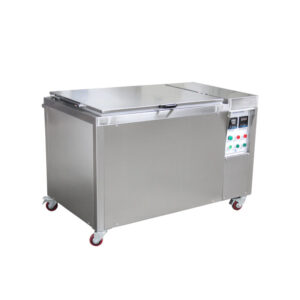
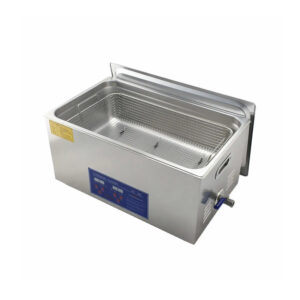
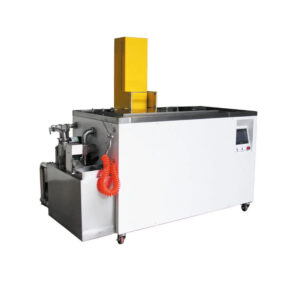
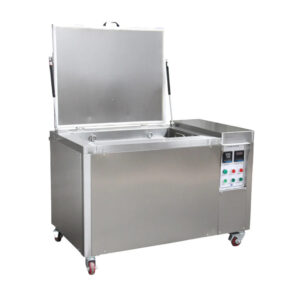
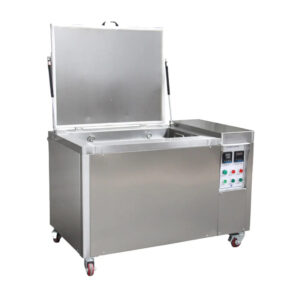

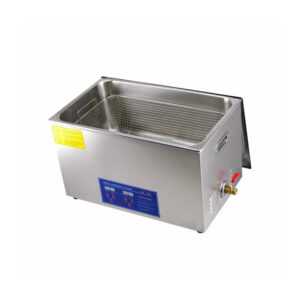
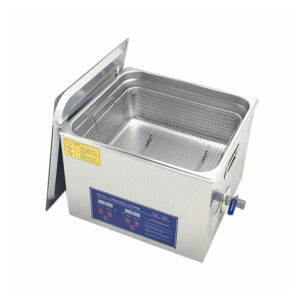
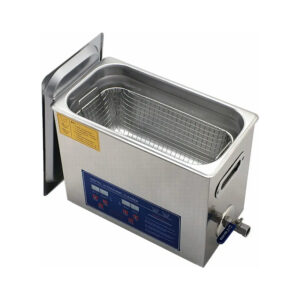
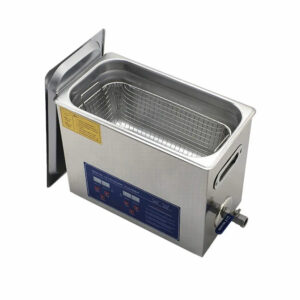
An ultrasonic cleaner is a precision cleaning device that uses high-frequency sound waves, often between 28 kHz and 40 kHz, to generate microscopic cavitation bubbles in a liquid bath. These bubbles implode and remove contaminants from surfaces, crevices, and cavities. Commonly used in industrial cleaning, equipment maintenance, tool reconditioning, and parts preparation, it serves professionals seeking reliable machinery and surface treatment solutions.
This category comprises various industrial-grade ultrasonic cleaners in sizes ranging from compact table-top units to large-capacity machines. You will find digital models designed for precise control and smaller items, and large bath systems with volumes up to several hundred liters. One model includes a lifting platform. Equipment with capacity in the 6 to 30 liter range features digital displays, while the larger units (over 100 liters) are floor-standing machines often with fixed tanks and higher power ratings.
Ultrasonic cleaners are utilised where precision cleaning is essential—such as removing oil, grease, rust or scale from metal parts, preparing components before coatings, or cleaning medical or laboratory instruments. These devices are important in aerospace, automotive rebuilding, tool manufacturing, electronics, and industrial maintenance. Secondary terms like ultrasonic bath cleaning, degreasing solutions, and fine parts cleaning often accompany search queries in procurement and engineering contexts.
Ultrasonic cleaners consist of a tank or bath filled with a suitable liquid, typically aqueous detergent or solvent, into which ultrasonic transducers introduce sound waves. Key technical parameters include tank volume (from around 6 liters up to 430 liters in this range), frequency (notably 28 kHz or 40 kHz), ultrasonic power (hundreds of watts to several kilowatts), and temperature control (commonly 20 °C to 80 °C). Additional features may include lifting platforms for large items, digital timers, basket inclusion, degassing functions, filtration and oil skimmers.
Functional variations among these cleaners depend on capacity, whether they are table models or floor-standing units, and whether they offer additional automation like lifting platforms. For example, smaller digital units provide flexibility and control for delicate parts; large tanks with higher ultrasonic power and accessories serve heavy-duty industrial applications. Consider compatibility with materials—only water-resistant components are suitable. Standards such as CE marking indicate compliance with relevant safety, electrical, and electromagnetic regulations. Other considerations include duty cycle, power supply compatibility, and environmental operating conditions, such as ambient temperature and humidity.
MEMIDOS offers a global B2B platform connecting industrial buyers and suppliers without intermediaries. Buyers access industrial ultrasonic cleaners directly from verified manufacturers and suppliers, avoiding middle men and enabling more efficient procurement with competitive pricing. The platform uses a secure escrow payment mechanism that holds funds until order conditions such as shipment are met, offering protection for buyers and payment reliability for suppliers. International procurement is simplified, with enhanced transparency in sourcing high-quality industrial equipment.
English
Български (Bulgarian)
Hrvatski (Croatian)
Čeština (Czech)
Dansk (Danish)
Nederlands (Dutch)
Suomi (Finnish)
Français (French)
Deutsch (German)
Ελληνικά (Greek)
Magyar (Hungarian)
Italiano (Italian)
Norsk bokmål (Norwegian Bokmål)
Polski (Polish)
Português (Portuguese (Portugal))
Română (Romanian)
Русский (Russian)
Español (Spanish)
Svenska (Swedish)
Türkçe (Turkish)