
Cart
No products in the cart.
 English
 Български (Bulgarian)
 Hrvatski (Croatian)
 Čeština (Czech)
 Dansk (Danish)
 Nederlands (Dutch)
 Suomi (Finnish)
 Français (French)
 Deutsch (German)
 Ελληνικά (Greek)
 Magyar (Hungarian)
 Italiano (Italian)
 Norsk bokmål (Norwegian Bokmål)
 Polski (Polish)
 Português (Portuguese (Portugal))
 Română (Romanian)
 Русский (Russian)
 Español (Spanish)
 Svenska (Swedish)
 Türkçe (Turkish)
Showing all 4 resultsSorted by popularity
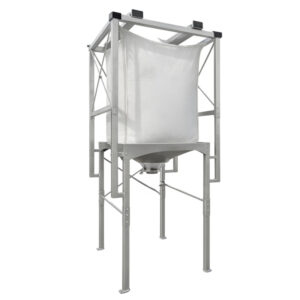
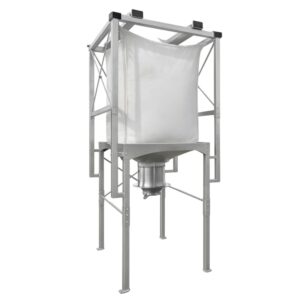
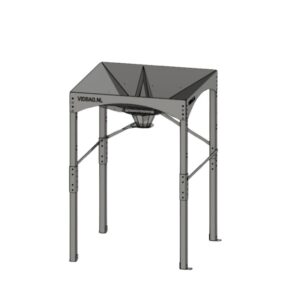
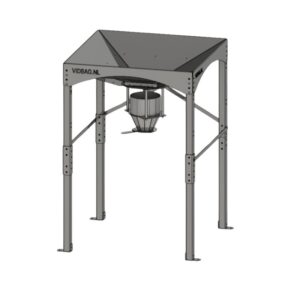
Big bag discharge stations in stainless steel are industrial equipment designed for emptying large bulk bags safely and effectively. These units feature frames and discharge mechanisms crafted from stainless steel (often grade 304), ideal for hygienic environments. They are used when controlled flow, dosage, or precise discharge of powders, granular materials, and non-rolling or free-flowing bulk products is required.
This category includes big bag discharge stations built entirely or partly with stainless steel, tailored to different discharge methods. You’ll find stations configured with spikes for cutting open bags without a discharge spout, and funnel-type stations for bags with spouts. There are also variants designed for powder and non-rolling materials. All stations are rated to handle high capacities (around two tonnes), fitted with precise stainless steel dosing valves that enable leak-free control.
These stainless steel discharge stations are employed in industries where product purity and material handling precision are essential. Sectors such as food processing, pharmaceuticals, ingredients manufacture, and chemical production rely on them. They serve secondary uses in handling free-flowing bulk goods like seeds or beans, and also in processing non-rolling materials such as powders or flour. Industries requiring strict sanitary standards or traceability use material-certified stainless steel stations to maintain hygiene and regulatory compliance.
A stainless steel discharge station is a structural frame built to support a full bulk bag (big bag) and allow controlled discharge through a valve or discharge mechanism. Its primary function is to convert a bulk bag into a temporary silo or feeder, enabling dosage or full unloading while preventing contamination and spillage.
Key technical characteristics include the use of stainless steel grade 304 throughout the frame, valve, and contact surfaces. Capacity is typically up to 2,000 kg. Dimensions and weight vary: for example, a station with spike or funnel design may measure approximately 1,130×1,130×1,642 mm and weigh around 120 kg. Valve design is critical—stainless steel dosing or butterfly valves are employed to ensure leak-tight control.
Typical use cases: discharging free-flowing products like pellets, seeds, or grains; handling non-rolling materials such as powder or flour; converting bulk bags without spouts via spike cutting; and bags with spouts via funnel connection. Key variations include spike vs funnel discharge types, and standard frame vs versions with lifting beams for non-rolling materials. Regulatory compliance often involves material certificates and sealing standards suitable for food or pharmaceutical environments.
When selecting a station, considerations include environmental exposure (corrosion risk, cleaning requirements), load capacity, compatibility with bag types (spout vs no spout), discharge mechanism (valve type, funnel or spike), and dimensional tolerances (footprint, height). Certifications like material certificate for stainless steel, hygiene compliance, and industry norms (for food/pharma) are important for integration into compliant systems.
MEMIDOS operates as a global B2B platform specialising in industrial products. It enables direct purchasing from verified manufacturers and suppliers, eliminating intermediaries. This delivers greater procurement efficiency and supports more competitive pricing. Payment processes are escrow-based: funds are held by MEMIDOS until order conditions such as shipment are met, providing protection for buyers and ensuring payment reliability for suppliers. Buyers benefit from transparent sourcing and access to high-quality equipment from certified suppliers worldwide, simplifying international procurement.
English
Български (Bulgarian)
Hrvatski (Croatian)
Čeština (Czech)
Dansk (Danish)
Nederlands (Dutch)
Suomi (Finnish)
Français (French)
Deutsch (German)
Ελληνικά (Greek)
Magyar (Hungarian)
Italiano (Italian)
Norsk bokmål (Norwegian Bokmål)
Polski (Polish)
Português (Portuguese (Portugal))
Română (Romanian)
Русский (Russian)
Español (Spanish)
Svenska (Swedish)
Türkçe (Turkish)