
Cart
No products in the cart.
 English
 Български (Bulgarian)
 Hrvatski (Croatian)
 Čeština (Czech)
 Dansk (Danish)
 Nederlands (Dutch)
 Suomi (Finnish)
 Français (French)
 Deutsch (German)
 Ελληνικά (Greek)
 Magyar (Hungarian)
 Italiano (Italian)
 Norsk bokmål (Norwegian Bokmål)
 Polski (Polish)
 Português (Portuguese (Portugal))
 Română (Romanian)
 Русский (Russian)
 Español (Spanish)
 Svenska (Swedish)
 Türkçe (Turkish)
Showing all 3 resultsSorted by popularity
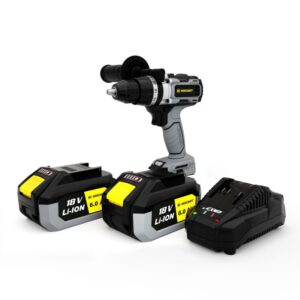
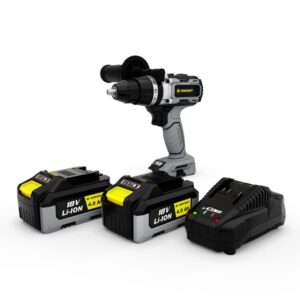
Battery drilling machines are cordless power tools using rechargeable batteries to drive drills, drivers, and hammer drills. Designed for industrial use, they enable drilling, fastening, and occasional hammer action without direct wired power, suitable for work on wood, metal, masonry, or construction site applications. Typical technical specifications engineers and procurement teams review include chuck capacity (for example 13 mm), battery type and capacity, and motor speed control.
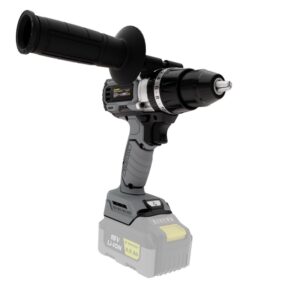
This category includes cordless drilling machine sets supplied with various battery capacities, chargers, and carrying accessories, alongside stand-alone cordless drill drivers with hammer function but without batteries or chargers. All items feature a 13 mm chuck capacity, and offer a speed range of roughly 500–2000 RPM. Accessories such as fabric bags or side handles are included in some full sets, while others focus only on the tool body with LED illumination and ergonomic features.
Battery drilling machines are used where portable drilling or screw-driving is required. In construction, they are employed for fastening to timber or metal studs, anchoring into masonry, or installing fixtures. In maintenance or facility services, they enable efficient assembly or repair without extension cords. Common product variants include cordless hammer-drill drivers and variable-speed cordless drills. These tools are common in mechanical workshops, site installations, renovation projects, or wherever both power and mobility are needed.
Battery drilling machines are defined by their power source (rechargeable Li-ion batteries), their chuck capacity (e.g. 13 mm), their speed range (500-2000 revolutions per minute), and whether they include a hammer or impact mechanism. Materials for housings typically include composite plastics and metal for durability, with ergonomic bearings or handles. Key performance parameters include battery voltage and amp-hour rating (e.g. 4Ah or 6Ah), torque control settings, and LED lighting for visibility in low-light conditions. Variations include complete drill sets with batteries, charger and bag; and bare tools with just the motor and chuck. Certifications such as CE compliance are relevant in many markets. Selection considerations include jobsite environment (humidity, temperature, dust), compatibility of battery platform, load demands (material hardness, bit size), operating cycles, and durability against mechanical and thermal stress.
MEMIDOS is a global B2B platform offering industrial battery drilling machines sourced directly from verified manufacturers and suppliers. Without intermediaries, the procurement process becomes more efficient and cost-transparent. Payments are handled securely using an escrow-based system, where funds are held by MEMIDOS until agreed order conditions such as shipment are met, protecting both buyer and supplier. Global purchasers gain access to high-quality industrial tools through a simplified and transparent sourcing channel suited to large scale, technical, or recurring purchases.
English
Български (Bulgarian)
Hrvatski (Croatian)
Čeština (Czech)
Dansk (Danish)
Nederlands (Dutch)
Suomi (Finnish)
Français (French)
Deutsch (German)
Ελληνικά (Greek)
Magyar (Hungarian)
Italiano (Italian)
Norsk bokmål (Norwegian Bokmål)
Polski (Polish)
Português (Portuguese (Portugal))
Română (Romanian)
Русский (Russian)
Español (Spanish)
Svenska (Swedish)
Türkçe (Turkish)