
Cart
No products in the cart.
 English
 Български (Bulgarian)
 Hrvatski (Croatian)
 Čeština (Czech)
 Dansk (Danish)
 Nederlands (Dutch)
 Suomi (Finnish)
 Français (French)
 Deutsch (German)
 Ελληνικά (Greek)
 Magyar (Hungarian)
 Italiano (Italian)
 Norsk bokmål (Norwegian Bokmål)
 Polski (Polish)
 Português (Portuguese (Portugal))
 Română (Romanian)
 Русский (Russian)
 Español (Spanish)
 Svenska (Swedish)
 Türkçe (Turkish)
Showing all 5 resultsSorted by popularity
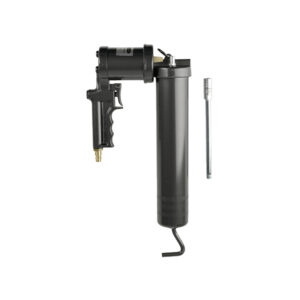
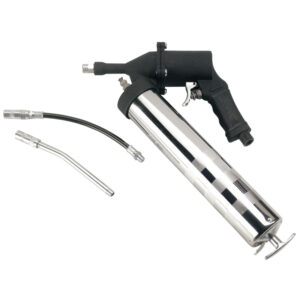
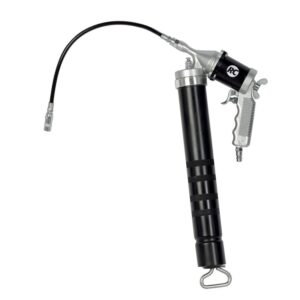
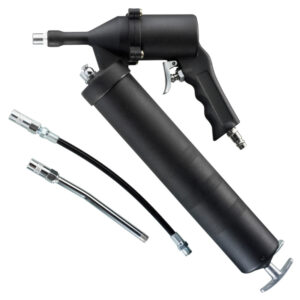
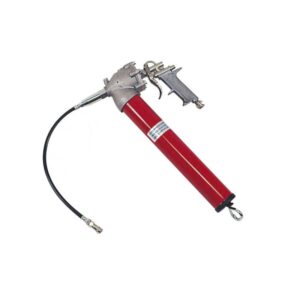
Grease guns (air / pneumatic) are tools powered by compressed air that deliver grease under pressure. Industrial professionals often need pneumatic grease guns with specifications like capacity in milliliters (ml), outlet pressure in bar, flow rate, coupling type, and compatibility with grease cartridges or bulk fill—important for demanding lubrication work in machinery maintenance and manufacturing environments. Such tools are essential in sectors where high-pressure lubrication systems and pneumatic operation are preferred.
This category includes pneumatic grease guns designed for different use cases: air-operated grease guns which take cartridges or bulk grease, models with rigid outlet pipes, those with flexible hoses, units compatible with hoses and cartridge sizes of 400 ml or 500 g, and designs featuring direct fill or dual filling options. Also present are two-hand-operated grease guns with hoses, tools fitted with hydraulic couplers, and guns specified for certain pressure ranges and nozzle styles.
These pneumatic grease guns are used in industrial lubrication tasks where precision and pressure control matter. They are often referred to as “air operated grease gun” and “continuous flow grease delivery.” Typical applications include lubrication of bearings, joints, gearboxes in automotive, machining, agricultural, and heavy equipment. They are also used in workshop maintenance, assembly lines, and wherever regular lubrication intervals are required under clean, high-pressure conditions.
Pneumatic grease guns function by using compressed air to push grease through a piston or diaphragm, supplying consistent flow and high outlet pressure. Key technical characteristics include capacity (commonly 400 ml or 500 g in this category), outlet pressure (ranges up to about 400–260 bar or more), stroke or flow rate (grams per stroke or continuous flow grams per minute), and the grease type compatibility, typically viscosity classes like NLGI 2. Materials for bodies and nozzles often include metal alloys with rigid or flexible delivery hoses, hydraulic couplers with multiple jaws (e.g., four-jaw), and rigid outlet pipes of specified lengths. Variations include direct fill vs cartridge fill, models with manual operation versus those using two hands or trigger mechanisms. Compliance markers such as CE marking are featured, ensuring adherence to safety and industrial standards. Selection considerations include the working pressure requirements, grease type and viscosity, required hose or nozzle configuration, environmental conditions (temperature, cleanliness), and the coupling compatibility with existing grease lines or fittings.
MEMIDOS is a global B2B platform offering industrial products directly from verified manufacturers and suppliers, avoiding intermediaries. Buyers benefit from more efficient procurement and competitive pricing, with secure escrow-based payment: funds are held until order conditions such as shipment are met, protecting both buyer and supplier. This structure supports access to high-quality industrial tools with transparency in sourcing, particularly useful for procurement professionals handling international purchases.
English
Български (Bulgarian)
Hrvatski (Croatian)
Čeština (Czech)
Dansk (Danish)
Nederlands (Dutch)
Suomi (Finnish)
Français (French)
Deutsch (German)
Ελληνικά (Greek)
Magyar (Hungarian)
Italiano (Italian)
Norsk bokmål (Norwegian Bokmål)
Polski (Polish)
Português (Portuguese (Portugal))
Română (Romanian)
Русский (Russian)
Español (Spanish)
Svenska (Swedish)
Türkçe (Turkish)