
Cart
No products in the cart.
 English
 Български (Bulgarian)
 Hrvatski (Croatian)
 Čeština (Czech)
 Dansk (Danish)
 Nederlands (Dutch)
 Suomi (Finnish)
 Français (French)
 Deutsch (German)
 Ελληνικά (Greek)
 Magyar (Hungarian)
 Italiano (Italian)
 Norsk bokmål (Norwegian Bokmål)
 Polski (Polish)
 Português (Portuguese (Portugal))
 Română (Romanian)
 Русский (Russian)
 Español (Spanish)
 Svenska (Swedish)
 Türkçe (Turkish)
Showing all 11 resultsSorted by popularity
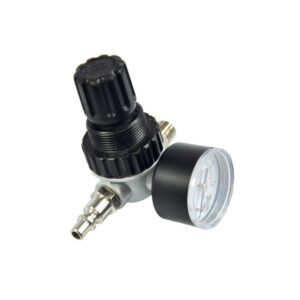
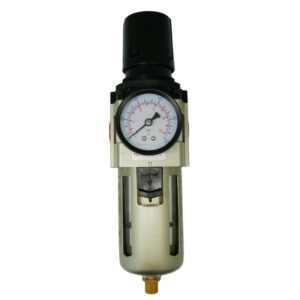
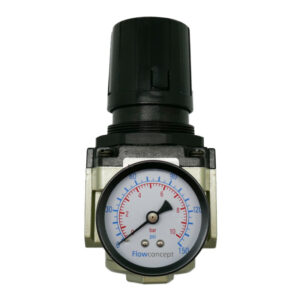
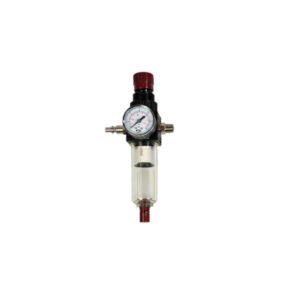
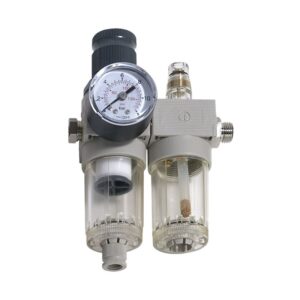
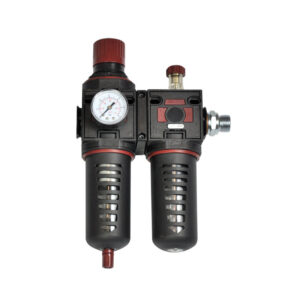
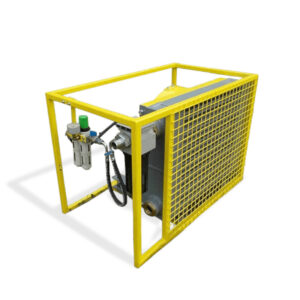
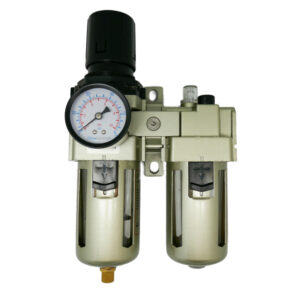
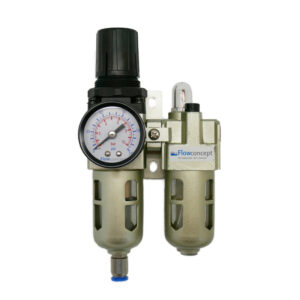
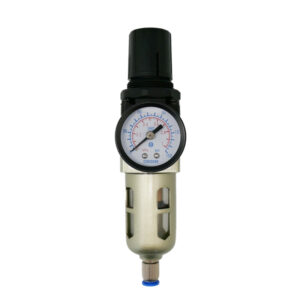
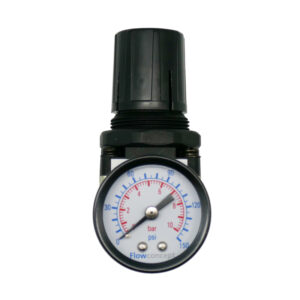
Air treatment refers to equipment designed to condition compressed air and regulate its pressure, filtration, moisture, and lubrication to ensure optimal performance in industrial and workshop pneumatic systems. In this category, you’ll find pressure regulators, filter regulators, lubricators, combined kits, and air coolers tailored for air treatment applications. These components are essential for maintenance, efficiency, and safety when working with compressed air and pneumatic tools.
This category includes several types of air treatment components. You will see pressure regulators in different sizes and thread types, such as ¼-inch and ½-inch regulators that specify a maximum pressure (typically around 10 bar). These regulators may also be integrated with filters and lubricators to perform multiple functions. There are also combined air treatment kits, which integrate regulator, filter, and lubricator units. One product diverges slightly—a movable air cooler—aimed at temperature control of compressed air.
Products in air treatment are used wherever compressed air systems operate—workshops, manufacturing plants, industrial automation. Regulators and filter regulators manage air pressure and remove particulates or moisture, supporting consistent performance of pneumatic tools like impact wrenches, grinders, or spray guns. Filter-regulator-lubricator (FRL) units maintain lubrication and extend tool life. The air cooler handles thermal management, preventing overheating in air lines. Common areas of concern are pneumatic filtration, pressure control, and air quality.
Air treatment components are designed to ensure that compressed air meets required performance and purity standards. Key technical characteristics include inlet and outlet thread dimensions (frequently ¼″ or ½″ BSP), maximum working pressures (often around 10 bar or 145 psi), and air flow capacity (ranging from several hundred to several thousand liters per minute depending on size and construction). Materials for housings may include aluminium or alloy bodies, with seals and filters using synthetic or polymer media. Variations within the category include standalone regulators, filter-regulators combining filtration with pressure control, and regulators with integrated lubricators (FRL units), differing in how they add lubrication and trap moisture or particles. Other technical parameters to consider are maximum air temperature, filtration micron rating, pressure drop across the component, and compatibility with actuator and hose diameters. Applicable standards often include CE marking and pneumatic safety norms. When selecting air treatment equipment, industrial buyers should account for supply pressure, downstream air demand, environmental factors (humidity, temperature, contamination), compatibility with existing piping or fittings, and required purity or lubrication level.
MEMIDOS offers a global B2B platform focused on connecting procurement professionals with manufacturers and verified suppliers of industrial products. Buyers can source air treatment components directly, without intermediaries, which supports efficient procurement and potentially more competitive pricing. All transactions are processed securely and escrow-based: funds are held until shipment or other agreed conditions are met, providing protection for buyers and ensuring reliability. The platform emphasizes transparency in sourcing and access to high-quality technical equipment from certified suppliers worldwide, making cross-border industrial procurement more straightforward.
English
Български (Bulgarian)
Hrvatski (Croatian)
Čeština (Czech)
Dansk (Danish)
Nederlands (Dutch)
Suomi (Finnish)
Français (French)
Deutsch (German)
Ελληνικά (Greek)
Magyar (Hungarian)
Italiano (Italian)
Norsk bokmål (Norwegian Bokmål)
Polski (Polish)
Português (Portuguese (Portugal))
Română (Romanian)
Русский (Russian)
Español (Spanish)
Svenska (Swedish)
Türkçe (Turkish)