
Cart
No products in the cart.
 English
 Български (Bulgarian)
 Hrvatski (Croatian)
 Čeština (Czech)
 Dansk (Danish)
 Nederlands (Dutch)
 Suomi (Finnish)
 Français (French)
 Deutsch (German)
 Ελληνικά (Greek)
 Magyar (Hungarian)
 Italiano (Italian)
 Norsk bokmål (Norwegian Bokmål)
 Polski (Polish)
 Português (Portuguese (Portugal))
 Română (Romanian)
 Русский (Russian)
 Español (Spanish)
 Svenska (Swedish)
 Türkçe (Turkish)
Showing 17–17 of 17 resultsSorted by popularity
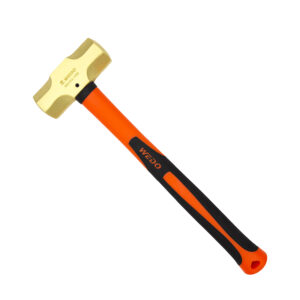
The Hammers - Brass category covers striking tools constructed with brass heads intended for industrial environments where non-sparking materials, surface protection, or reduced rebound are essential. Ideal for operations in metalworking, machinery maintenance, assembly, and workshops, this category delivers brass hammers, brass mallets and related tools built for durability and precision. These tools align with buyer needs for quality industrial hand tools suited to non-sparking and surface-sensitive work.
In this collection you will discover a selection of brass hammers and mallets of different types and handle materials. Examples include double-face brass hammers with either wooden or fiberglass handles, brass ball pein hammers, brass sledge hammers of German type, scaling hammers, flat (Euro type) brass hammers, drum-type brass hammers or mallets, and general brass mallets with wooden or fiberglass handles. Each variant comes with size or weight options, enabling matching hammer mass to task requirements.
Brass hammers are widely used in settings where ferrous sparks must be avoided or delicate surfaces could be damaged by harder metals. In maintenance work on petrochemical plants, refineries, or explosive atmospheres, non-sparking brass tools reduce fire risk. In fabrication and assembly of soft alloys or precision machinery, brass mallets and ball pein hammers allow controlled impact without marring surfaces. When adjusting metal parts or removing scale, scaling hammers help clean welds or castings, while flat and sledge brass hammers support shaping, aligning, or light demolition tasks with low rebound.
Brass hammers are hand tools in which the striking face is made from brass—an alloy typically composed of copper and zinc—chosen for its lower hardness compared to steel. The primary function is to deliver impact force while reducing damage to target surfaces and limiting spark generation. Key technical parameters include head material hardness (often lower than HRC 50 to limit marks), head weight (ranges from hundreds of grams to several kilograms), handle material (wood or fiberglass) which affects vibration damping and durability.
Variations in this class arise by head shape (double face, ball pein, flat, sledge German type, drum), face profile and handle style. A ball pein hammer has one rounded face and one flat face for metal shaping; scaling hammers feature pointed or serrated edges for removing scale or weld flash; a sledge-type brass hammer uses a heavier head for heavier impact with larger mass. Performance parameters concern impact force, rebound, balance, and face deformation under load.
Selecting the correct type depends on environmental factors (corrosive, hazardous, or spark-sensitive), required force (weight and leverage), operating conditions (wet, oily, confined space), and workpiece material (softer metals, treated surfaces). Relevant standards such as DIN, ASME, or GB may apply to manufacturing tolerances, head hardness, marking, or safety labels. Compliance certifications ensure consistency in hardness, weight, handle retention, and material composition.
MEMIDOS is a global B2B platform serving industrial procurers, offering direct contact with manufacturers and suppliers, which eliminates intermediaries. This structure streamlines procurement processes and helps offer more competitive pricing. Transactions are protected by a secure escrow-based payment system, ensuring buyer funds are held until the order meets agreed conditions such as shipment. Industrial buyers can source verified, high-quality brass hammers and mallets with confidence. The platform supports international sourcing with transparent supplier credentials and technical data for evaluation.
English
Български (Bulgarian)
Hrvatski (Croatian)
Čeština (Czech)
Dansk (Danish)
Nederlands (Dutch)
Suomi (Finnish)
Français (French)
Deutsch (German)
Ελληνικά (Greek)
Magyar (Hungarian)
Italiano (Italian)
Norsk bokmål (Norwegian Bokmål)
Polski (Polish)
Português (Portuguese (Portugal))
Română (Romanian)
Русский (Russian)
Español (Spanish)
Svenska (Swedish)
Türkçe (Turkish)