
Cart
No products in the cart.
 English
 Български (Bulgarian)
 Hrvatski (Croatian)
 Čeština (Czech)
 Dansk (Danish)
 Nederlands (Dutch)
 Suomi (Finnish)
 Français (French)
 Deutsch (German)
 Ελληνικά (Greek)
 Magyar (Hungarian)
 Italiano (Italian)
 Norsk bokmål (Norwegian Bokmål)
 Polski (Polish)
 Português (Portuguese (Portugal))
 Română (Romanian)
 Русский (Russian)
 Español (Spanish)
 Svenska (Swedish)
 Türkçe (Turkish)
Showing 17–18 of 18 resultsSorted by popularity
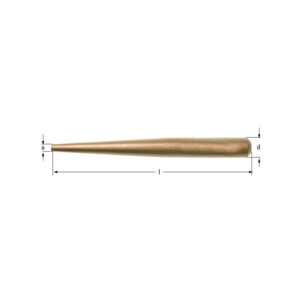
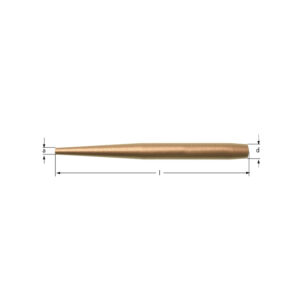
Mandrels and pins non-sparking are specialised non-magnetic hand tools designed to avoid spark generation in hazardous environments. Comprising mandrels, pins, punch-type tools and drift pins, these non-sparking tools are typically made from materials such as aluminium bronze and beryllium copper. They serve key roles in industrial maintenance, fabrication and repair in zones where flammable vapors or combustible dust are present.
In this section you’ll find several types of non-sparking mandrels and pins, including straight pins or pull mandrels, drift pins or mandrels conical, barrel-type drift pins through-drivers (spindle-shaped), pin punches or drive mandrels, centre punches or dive pins, and awls or prickers. These items come in variants of aluminium bronze (AlBz) or beryllium copper (BeCu). Sizes vary by length and diameter depending on the specific tool type and its intended use.
Non-sparking mandrels and pins are deployed where ignition risk must be minimised, such as in petrochemical plants, gas extraction or explosion risk zones (ATEX environments). Straight pins and pull mandrels are often used for alignment, assembly or fixing components. Drift pins or drive mandrels serve to force out pins or bolts in machinery disassembly. Centre punches enable marking or initiating a hole before drilling. The awls or prickers are used for scribing or surface marking. Secondary terms include non-magnetic tools and explosion‐proof safety tools in industries like oil & gas, chemical processing, mining, or any plant requiring strict spark-resistance and non-magnetism.
This category covers solid mandrels and pins whose primary function is to transmit force or to align components without producing sparks. Key technical characteristics are the material composition—aluminium bronze or beryllium copper—alloys chosen for their low magnetic permeability and ability to resist ignition under impact. Sizing parameters include diameter (d), length (l), and specific dimensions such as a × d × l or d × l, depending on tool type.
Performance parameters may include compliance with standards for impact energy (e.g. tools tested under EN 80079-38 for non-sparking behavior and withstanding impact energies up to around 102 J), as well as conformity to ATEX directive classifications for explosion risk zones. Tolerances relate to dimensional accuracy to ensure proper fit in holes or between components.
Common variations: straight pins vs angled or offset pins; drift pins vs pull mandrels; centre punches vs prickers. Each differs in shape, force direction, or point type. Material choice influences corrosion resistance, magnetic behavior and durability. Use conditions such as wet or corrosive environment, temperature, mechanical load, and magnetic sensitivity affect selection.
MEMIDOS is a global B2B platform connecting industrial buyers with verified manufacturers and suppliers, enabling direct procurement without intermediaries. Buyers benefit from transparency and competitive pricing by eliminating middle men. Payment is handled securely via escrow, with funds held by MEMIDOS until shipment or order conditions are met, providing buyer protection and supplier payment reliability. The range includes high-quality mandrels and pins crafted in materials like aluminium bronze and beryllium copper for demanding industrial and explosion risk environments. The platform simplifies international sourcing and offers clarity in standards, material grades, and supply options.
English
Български (Bulgarian)
Hrvatski (Croatian)
Čeština (Czech)
Dansk (Danish)
Nederlands (Dutch)
Suomi (Finnish)
Français (French)
Deutsch (German)
Ελληνικά (Greek)
Magyar (Hungarian)
Italiano (Italian)
Norsk bokmål (Norwegian Bokmål)
Polski (Polish)
Português (Portuguese (Portugal))
Română (Romanian)
Русский (Russian)
Español (Spanish)
Svenska (Swedish)
Türkçe (Turkish)