
Cart
No products in the cart.
 English
 Български (Bulgarian)
 Hrvatski (Croatian)
 Čeština (Czech)
 Dansk (Danish)
 Nederlands (Dutch)
 Suomi (Finnish)
 Français (French)
 Deutsch (German)
 Ελληνικά (Greek)
 Magyar (Hungarian)
 Italiano (Italian)
 Norsk bokmål (Norwegian Bokmål)
 Polski (Polish)
 Português (Portuguese (Portugal))
 Română (Romanian)
 Русский (Russian)
 Español (Spanish)
 Svenska (Swedish)
 Türkçe (Turkish)
Showing 49–55 of 55 resultsSorted by popularity

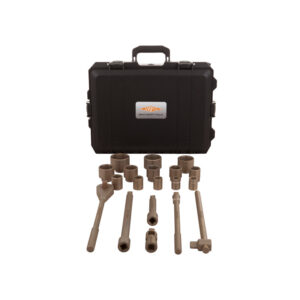
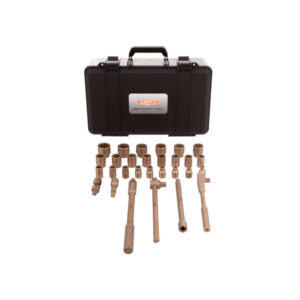
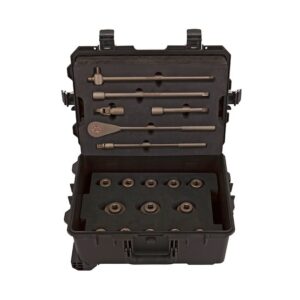
Socket spanner aluminium bronze (inch) refers to non-sparking, non-magnetic hand tools made from aluminium bronze alloy, with sockets sized in inch-drive measurements. These tools include socket spanners, adapters, joints, and ratchet wrenches using inch-based drive sizes such as ½″, ¾″, and 1″. They are suitable for non-sparking applications and are manufactured in aluminium bronze inch-drive configurations.
This category features a selection of socket spanner tools crafted in aluminium bronze, specifically with inch-drive ends. You will find sliding T-handle socket spanners in ½″, ¾″ and 1″ drives, universal joints compatible with impact wrench or socket spanner in similar inch sizes, adapter/converter pieces converting between inch drive sizes, hinged socket spanners, speed handle wrenches, and ratchet wrenches. Each product type shares the material property (aluminium bronze) and drive specification (inch), assuring consistency across the range.
These socket spanner tools are used in environments where sparks or magnetic interference pose safety or operational risks, such as gas processing plants, oil and gas, mining, and petrochemical facilities. Industries working with volatile gases or flammable materials require tools made of aluminium bronze to avoid ignition. These tools are non-sparking, inch-drive socket tools suited for use in hazardous environments. These tools also serve in maintenance and repair operations on pipelines, valves, and flanged connections where inch drive sizes match existing fasteners.
The socket spanner aluminium bronze inch tools are hand-operated devices designed to fit and turn fasteners via socket interface. Primary function: transmit torque via an inch-drive square profile (commonly ½″, ¾″, 1″) to sockets, joints, or extensions. Aluminium bronze offers non-sparking behavior and non-magnetic properties, important for hazardous or sensitive operations.
Key technical characteristics include drive size (e.g. ½″, ¾″, 1″), material composition (aluminium bronze alloy), tool type (sliding T-handle, universal joint, ratchet wrench, adapter/converter, hinged socket spanner, speed handle wrench), and functional geometry (e.g. hinged heads, sliding bars, speed handles for quick rotation). Performance parameters include torque capacity determined by drive size and handle design, joint articulation in universal joints, and conversion accuracy in adapters. Tolerances in drive square mating surfaces are critical for fit and torque transmission.
Common variations differ by drive size, handle style (sliding vs fixed cross-bar vs ratcheting mechanisms), joint mechanisms (universal vs swivel vs hinged), and converter types that allow interdrive adaptation (for example converting ¾″ to 1″). Tools may differ in head geometry and joint flexibility, affecting reach and angle constraints.
Standards and compliance factors: tools may adhere to international drive profile and socket standards to ensure compatibility with inch-drive sockets; non-sparking material standards and safety regulations for tools used in explosive atmospheres may apply where aluminium bronze is specified. Certification for material composition (ensuring alloy copper content, aluminium content, lead or arsenic limits) may be relevant.
Selection considerations include the environment (flammable, explosive, magnetic sensitivity), required torque capacity, drive size compatibility with existing sockets, geometry constraints (space, access, joint angle), and tool functionality (e.g. ability to convert between drive sizes or use a universal joint). Materials properties such as resistance to corrosion or thermal exposure may also influence choices.
MEMIDOS operates as a global B2B industrial platform, connecting buyers directly with manufacturers and verified suppliers of industrial tools. Procurement through MEMIDOS takes place without intermediaries, enabling efficient purchasing and more competitive pricing. Payments are governed by a secure escrow system, where funds are held until order conditions, including shipment, are satisfied, providing protection for both buyer and supplier. Buyers gain access to high-quality, non-sparking socket spanner tools in aluminium bronze made by proven suppliers. The platform supports easier international sourcing, offering greater transparency in specifications, supplier credentials, and delivery parameters for industrial professionals.
English
Български (Bulgarian)
Hrvatski (Croatian)
Čeština (Czech)
Dansk (Danish)
Nederlands (Dutch)
Suomi (Finnish)
Français (French)
Deutsch (German)
Ελληνικά (Greek)
Magyar (Hungarian)
Italiano (Italian)
Norsk bokmål (Norwegian Bokmål)
Polski (Polish)
Português (Portuguese (Portugal))
Română (Romanian)
Русский (Russian)
Español (Spanish)
Svenska (Swedish)
Türkçe (Turkish)