
Cart
No products in the cart.
 English
 Български (Bulgarian)
 Hrvatski (Croatian)
 Čeština (Czech)
 Dansk (Danish)
 Nederlands (Dutch)
 Suomi (Finnish)
 Français (French)
 Deutsch (German)
 Ελληνικά (Greek)
 Magyar (Hungarian)
 Italiano (Italian)
 Norsk bokmål (Norwegian Bokmål)
 Polski (Polish)
 Português (Portuguese (Portugal))
 Română (Romanian)
 Русский (Russian)
 Español (Spanish)
 Svenska (Swedish)
 Türkçe (Turkish)
Showing 49–57 of 57 resultsSorted by popularity
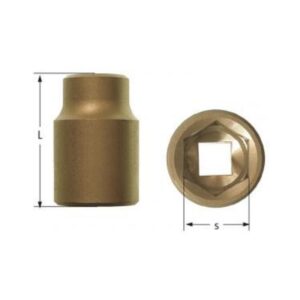
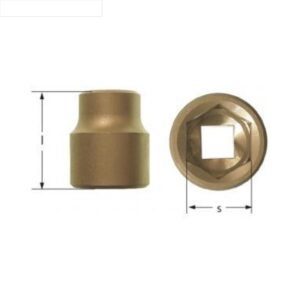
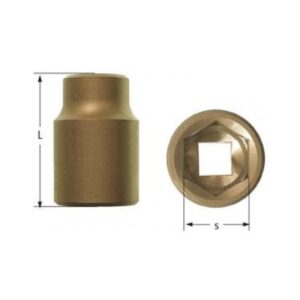
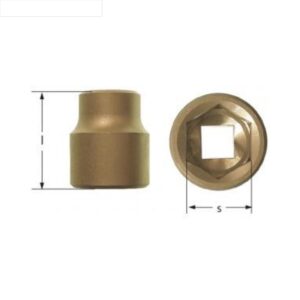
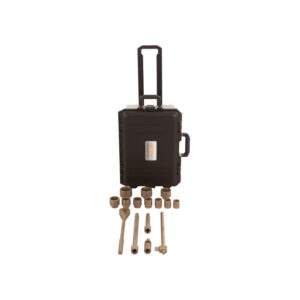
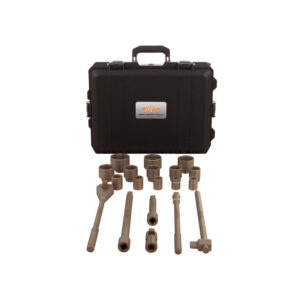
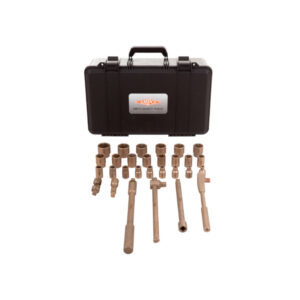
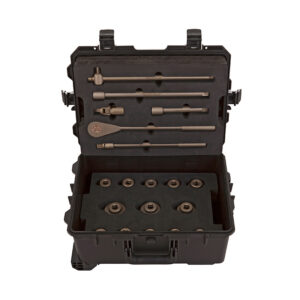
Socket Spanner – Aluminium Bronze (Metric) refers to non-sparking, non-magnetic socket wrenches, socket heads, drive bars and related attachment tools made from aluminium bronze alloy, sized in metric measurements. These tools are intended for use in environments where risk of ignition must be minimised and where precise torque application is required.
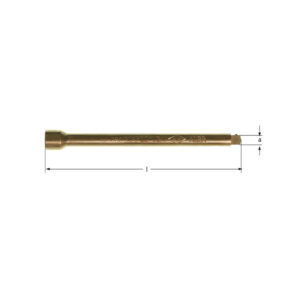
In this category you will find metric socket wrenches, both straight and angled (hexagonal L-type), metric socket heads for socket wrenches and for impact wrenches with various drive sizes (½-inch, ¾-inch, 1-inch and larger), long socket heads, universal joints, adapters or converters, drive bars (specified by diameter × length), hinged socket spanners, speed handle wrenches, and ratchet wrenches—all constructed from aluminium bronze.
These tools are used primarily in industries employing flammable atmospheres, such as oil and gas, petrochemical plants, refineries, mining operations and chemical manufacturing. They are often certified as “ATEX-compliant” and described as “low-spark hand tools” in safety documentation. Operations involving shipyards, explosions risk zones, high-voltage or magnetic-sensitive environments also require aluminium bronze metric socket spanners for maintenance, assembly of equipment, fastener removal, and torque fitting tasks.
The main function of aluminium bronze metric socket spanners and associated tools is to apply torque to fasteners (bolts, nuts, screws) in settings where spark risk or magnetic interference must be avoided. These tools are made of aluminium bronze alloy (AlBz), chosen for both its non-sparking and non-magnetic properties. Key technical parameters include drive sizes (e.g., ½-in, ¾-in, 1-in, 1-½-in), metric socket sizes (from small metric such as 6-mm up to large-scale sizes over 100-mm), bar diameters and lengths for drive bars (e.g., 6 × 150 mm, 38 × 1000 mm), hinge or sliding-T mechanics for access, conversion adapters between drives, universal joints for angular flexibility, and ratchet or speed handles for speed or leverage. Compliance with safety standards is visible, such as certification to ATEX zones and EN 80079-38 for impact energy testing up to 102 J, and magnetic permeability under specified thresholds. Key selection considerations include the tool environment (hazardous atmosphere, corrosion exposure), compatibility of drive size and fastener size, type of wrench head (standard hex, L-type, hinged, universal joint), length and reach, and mechanical limits such as impact vs manual torque rating and tolerances of socket fit.
MEMIDOS operates as a global B2B platform connecting industrial buyers with manufacturers and verified suppliers directly. Through MEMIDOS you procure socket spanners and related aluminium bronze metric tools without intermediaries, contributing to increased procurement efficiency and more competitive pricing. The platform utilises secure, escrow-based payment handling, wherein funds are held until shipment or agreed order conditions are met, offering protection for buyers while ensuring suppliers receive reliable payment. The product range is from verified industrial tool manufacturers, simplifying international sourcing with greater transparency in specifications, material standards, and safety certifications.
English
Български (Bulgarian)
Hrvatski (Croatian)
Čeština (Czech)
Dansk (Danish)
Nederlands (Dutch)
Suomi (Finnish)
Français (French)
Deutsch (German)
Ελληνικά (Greek)
Magyar (Hungarian)
Italiano (Italian)
Norsk bokmål (Norwegian Bokmål)
Polski (Polish)
Português (Portuguese (Portugal))
Română (Romanian)
Русский (Russian)
Español (Spanish)
Svenska (Swedish)
Türkçe (Turkish)