
Cart
No products in the cart.
 English
 Български (Bulgarian)
 Hrvatski (Croatian)
 Čeština (Czech)
 Dansk (Danish)
 Nederlands (Dutch)
 Suomi (Finnish)
 Français (French)
 Deutsch (German)
 Ελληνικά (Greek)
 Magyar (Hungarian)
 Italiano (Italian)
 Norsk bokmål (Norwegian Bokmål)
 Polski (Polish)
 Português (Portuguese (Portugal))
 Română (Romanian)
 Русский (Russian)
 Español (Spanish)
 Svenska (Swedish)
 Türkçe (Turkish)
Showing 1–16 of 39 resultsSorted by popularity

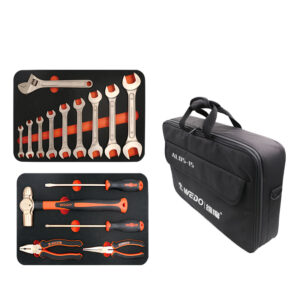
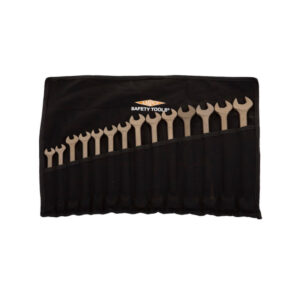
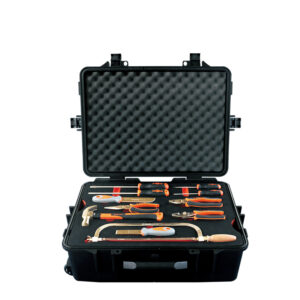
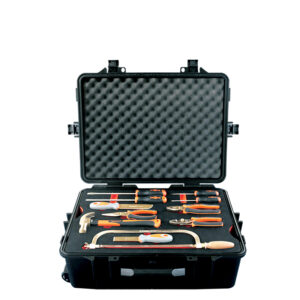
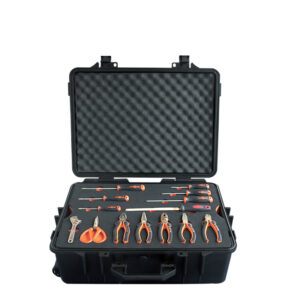
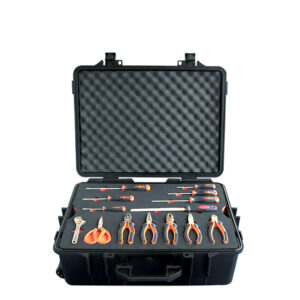
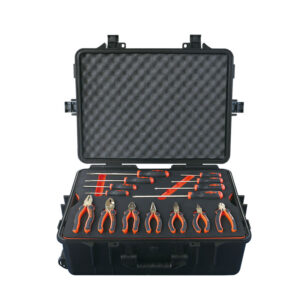
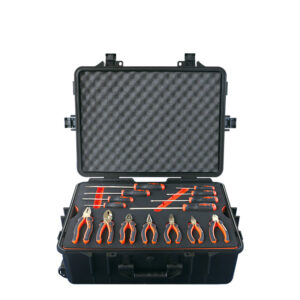
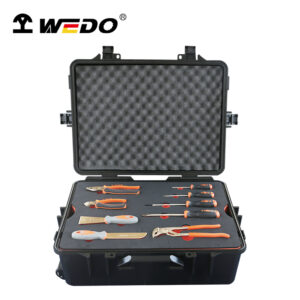
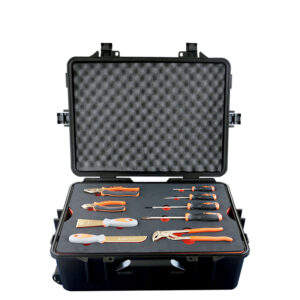
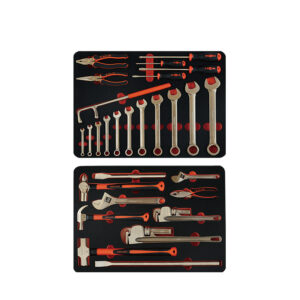
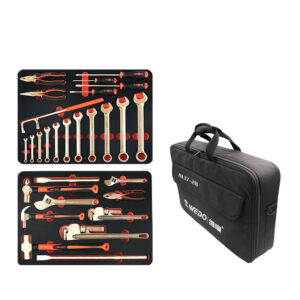
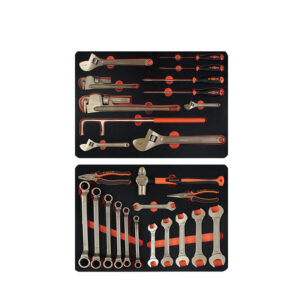
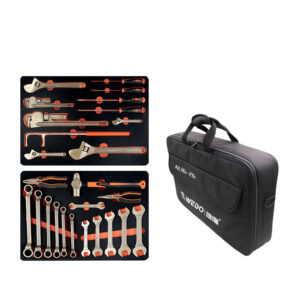
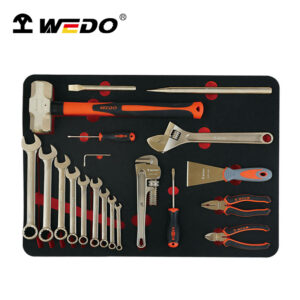
This category features non-spark sets of hand tools designed for industrial environments where sparks or magnetic fields must be avoided. These tools are made of non-sparking, non-magnetic alloys such as aluminium bronze and beryllium copper, often certified to ATEX or BAM certifications. These sets are suitable for professionals seeking safety-rated, durable hand tools for explosion-risk zones, hazardous atmospheres, or metal-sensitive operations.
Here you’ll see tool sets comprised of multiple pieces—ranging from 16-piece to over 50-piece kits—made specifically from aluminium bronze or beryllium copper. Each set includes a variety of tools such as hammers, wrenches, pliers, screwdrivers, chisels, knives, and related accessories. Every set comes with a fitted tool case, often with foam inserts, to organise and protect the tools. Many kits are ATEX or BAM certified, indicating they meet safety criteria for use in hazardous environments.
Non-sparking tool sets are essential in industries handling flammable gases, vapours, or combustible dusts—such as petrochemical plants, oil and gas pipelines, power generation, mining, and chemical processing. They are used during maintenance, assembly, shutdowns, and emergency repairs where ignition risks must be managed. They are often referred to as “explosion-proof hand tools” or “hazardous area safety tools.” These sets also serve in environments sensitive to magnetic interference or metallic contact.
The primary function of non-sparking tool sets is to minimise risk when working in explosion-hazard atmospheres or environments sensitive to sparks. Tools in this category are constructed from copper-based alloys—such as beryllium copper and aluminium bronze—that do not produce sparks upon impact and are non-magnetic. These materials undergo heat treatment to achieve hardness levels in the range of approx. 30-40 HRC for durability and wear resistance. Certifications like ATEX and BAM are common, ensuring compliance with safety standards for use in flammable atmospheres. Sets vary by number of pieces, tool types included, size (metric or inch), and case organisation. Key technical parameters include alloy type, hardness rating, piece count, non-magnetic property, spark-risk classification, and suitability for environments with specific gas concentrations (e.g., hydrogen levels). Important selection considerations involve the operating atmosphere, required certifications, dimensional accuracy of tools (wrench sizes, pliers length, etc.), environmental conditions (temperature, humidity), and the specific tasks to be performed—repair, operation, maintenance.
MEMIDOS is a global B2B platform offering direct access to manufacturers and verified suppliers of industrial non-sparking tool sets without middlemen. This ensures procurement professionals source safety-rated aluminium bronze or beryllium copper kits with favourable operational costs. Payment is secured via an escrow system: funds are held by MEMIDOS until order conditions—such as shipment—are satisfied, offering protection to buyers and assurance to suppliers. Buyers gain transparent access to a wide range of high-quality, certified tool sets for hazardous or explosion-risk environments, all facilitated through one international marketplace.
English
Български (Bulgarian)
Hrvatski (Croatian)
Čeština (Czech)
Dansk (Danish)
Nederlands (Dutch)
Suomi (Finnish)
Français (French)
Deutsch (German)
Ελληνικά (Greek)
Magyar (Hungarian)
Italiano (Italian)
Norsk bokmål (Norwegian Bokmål)
Polski (Polish)
Português (Portuguese (Portugal))
Română (Romanian)
Русский (Russian)
Español (Spanish)
Svenska (Swedish)
Türkçe (Turkish)