
Cart
No products in the cart.
 English
 Български (Bulgarian)
 Hrvatski (Croatian)
 Čeština (Czech)
 Dansk (Danish)
 Nederlands (Dutch)
 Suomi (Finnish)
 Français (French)
 Deutsch (German)
 Ελληνικά (Greek)
 Magyar (Hungarian)
 Italiano (Italian)
 Norsk bokmål (Norwegian Bokmål)
 Polski (Polish)
 Português (Portuguese (Portugal))
 Română (Romanian)
 Русский (Russian)
 Español (Spanish)
 Svenska (Swedish)
 Türkçe (Turkish)
Showing 17–21 of 21 resultsSorted by popularity
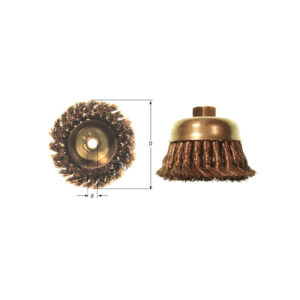
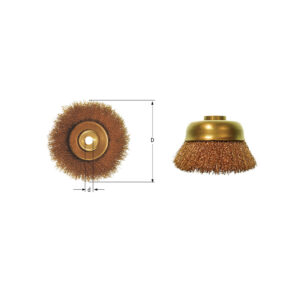
The category “wire brushes – non-sparking” comprises safety brushes specifically designed for industrial environments where ignition risk and magnetic sensitivity are concerns. These tools use non-sparking, non-magnetic materials such as phosphor bronze or other copper-based alloys. They are intended for surface preparation, cleaning welds, removing paint or corrosion where ordinary steel brushes might cause sparks, risk explosions, or interfere with magnetic components.
Within this category, you will find various non-sparking wire brushes including cup brushes, wheel brushes with knot wire, rotating end brushes, tube brushes, flat-back brushes, and scrubbing brooms. Some brushes are designed with curved handles, shoe-handles or flat backs for manual use. Others include drive-shafts for wheel brushes, spark-plug cleaning brushes, brooms with multiple rows for larger surface cleaning, and brush heads adapted to power tools. The finishes or wire types include phosphor bronze, knot wire, crimped wire and phosphate coatings.
These non-sparking wire brushes are used in industries such as petrochemical, oil and gas, aerospace, mining, and food processing, where explosion-proof tools are required. They serve to clean weld seams, remove rust or scale, prepare surfaces for coating or bonding, and clean delicate components without risk of ignition or magnetic interference. Some models are ATEX certified and specifically designed as non-magnetic cleaning tools. The products help ensure safety in hazardous zones, improve surface finish and reduce downtime for inspections or maintenance.
Wire brushes in this category are constructed using non-ferrous copper alloys such as phosphor bronze or similar copper-nickel materials. These materials exhibit low magnetic permeability and do not produce sparks when striking hard surfaces. Brushes are sized by dimensions such as bristle length, diameter, number of rows, and wire knot style or crimped wire structure. Cup brushes and wheel brushes are designed for use with power tools; hand brushes like scrubbing brooms, flat-back or shoe-handle brushes are for manual application.
Technical variations include wire knot vs. crimped wire (knot wire tends to be more aggressive), phosphor bronze vs. phosphate finish, and whether the brush attaches to a drive shaft or is handheld. Performance parameters may include wear resistance, corrosion resistance, RPM limits for rotating brush types, and compliance with safety standards such as EN 80079-38 for non-sparking tools and European ATEX directives for hazardous environments. Selection must consider operating environment (flammable gases or dust), magnetic sensitivity, tool compatibility (size, drive shaft, power tool fitting), and surface material (steel, aluminum, composites), ensuring the brush material does not damage substrate or equipment.
MEMIDOS is a global B2B platform specializing in industrial products where buyers can source non-sparking wire brushes directly from verified manufacturers and suppliers. By removing intermediaries, procurement becomes more efficient with access to competitive pricing. Secure payment is managed via an escrow system: funds are held until order conditions such as shipment are fulfilled, providing protection for buyers while assuring suppliers of payment reliability. Industrial buyers benefit from access to high-quality non-magnetic cleaning tools and safety brushes across a broad range of materials and standards, with transparency in sourcing and international reach.
English
Български (Bulgarian)
Hrvatski (Croatian)
Čeština (Czech)
Dansk (Danish)
Nederlands (Dutch)
Suomi (Finnish)
Français (French)
Deutsch (German)
Ελληνικά (Greek)
Magyar (Hungarian)
Italiano (Italian)
Norsk bokmål (Norwegian Bokmål)
Polski (Polish)
Português (Portuguese (Portugal))
Română (Romanian)
Русский (Russian)
Español (Spanish)
Svenska (Swedish)
Türkçe (Turkish)