
Cart
No products in the cart.
 English
 Български (Bulgarian)
 Hrvatski (Croatian)
 Čeština (Czech)
 Dansk (Danish)
 Nederlands (Dutch)
 Suomi (Finnish)
 Français (French)
 Deutsch (German)
 Ελληνικά (Greek)
 Magyar (Hungarian)
 Italiano (Italian)
 Norsk bokmål (Norwegian Bokmål)
 Polski (Polish)
 Português (Portuguese (Portugal))
 Română (Romanian)
 Русский (Russian)
 Español (Spanish)
 Svenska (Swedish)
 Türkçe (Turkish)
Showing 17–21 of 21 resultsSorted by popularity
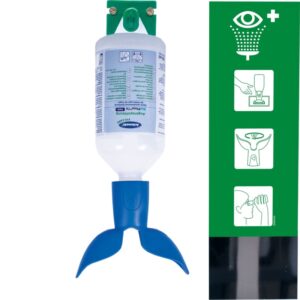
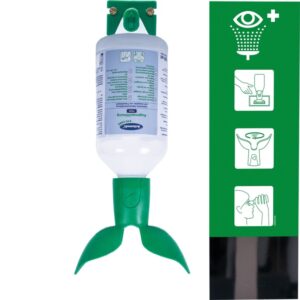
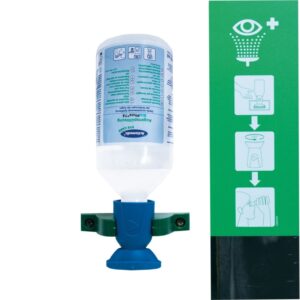
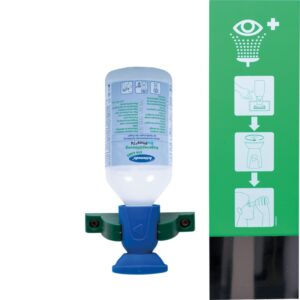
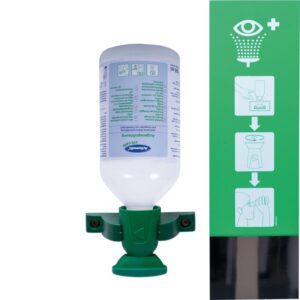
Eye wash refers to a specialized safety tool designed for flushing and cleansing the eyes in industrial settings. It includes sterile cleansing solutions, sprays, buffer fluids, and associated accessories that support emergency eye care and compliance with safety standards. Available options include sterilized solutions, buffer fluids, CE-marked products, spray formats, portable bottles, and eye wash accessories.
Within this category there are eye wash bottles containing sterile borate buffer solution or 0.9% sodium chloride solution, suitable for rinsing away contaminants and neutralizing acids or alkalis. You will also find eye wash sprays that deliver mist or stream applications, empty belt bags designed to carry specified bottle sizes, wall holders for storage of bottles, wall mount straps to secure bottles, and buffers such as phosphate-free borate solutions. Eye wash kits with twin-bottle configurations are also part of the collection.
Eye wash products are frequently used in chemical, laboratory, manufacturing, and construction environments where there is risk of exposure to dust, chemicals, acids, or alkaline substances. They serve as first response tools during emergency eye exposures when particles or hazardous fluids contact the eye surface. They are used for emergency eye care and are considered essential safety equipment. Industries operating with corrosive substances, airborne particulate, or high risk of mechanical eye injury rely on buffer solutions and spray formats for rapid decontamination and ongoing compliance.
Eye wash products are designed to provide immediate irrigation of the eye to remove foreign matter, neutralize chemicals and restore pH balance. Key technical characteristics include the fluid type—sterile borate buffer or isotonic saline (0.9% sodium chloride)—volume capacity (e.g. 235 ml, 500 ml), method of delivery (spray, bottle, twin-bottle), and accessory support such as belt bags, wall holders, or mounting straps. Buffer solutions often are phosphate-free and formulated to neutralize both acids and alkalis while preserving eye’s natural pH. Bottles may include features like ergonomic caps or built-in eyecups to maintain flow and support rinsing without waste. The bottles and accessories typically carry CE marking. Important technical variation arises in buffer vs. saline solutions and in packaging formats intended for portability or fixed installation. Selection considerations include environment (wet, dusty, or corrosive), exposure risk, the ease of access (mobile vs fixed), compatibility with existing first aid stations, shelf life, and storage conditions.
MEMIDOS operates globally as a B2B industrial marketplace connecting procurement professionals with verified manufacturers and suppliers. By facilitating direct purchasing without intermediaries, procurement cycles are simplified and supply costs become more transparent. MEMIDOS uses escrow-based payment protection so that funds are held until ordered goods are shipped or other specified conditions are met, safeguarding buyer’s interests. Industrial buyers gain access to high-quality emergency eye wash products, accessory components, and buffer solutions from reliable sources, enabling consistent safety compliance and more efficient international sourcing.
English
Български (Bulgarian)
Hrvatski (Croatian)
Čeština (Czech)
Dansk (Danish)
Nederlands (Dutch)
Suomi (Finnish)
Français (French)
Deutsch (German)
Ελληνικά (Greek)
Magyar (Hungarian)
Italiano (Italian)
Norsk bokmål (Norwegian Bokmål)
Polski (Polish)
Português (Portuguese (Portugal))
Română (Romanian)
Русский (Russian)
Español (Spanish)
Svenska (Swedish)
Türkçe (Turkish)