
Cart
No products in the cart.
 English
 Български (Bulgarian)
 Hrvatski (Croatian)
 Čeština (Czech)
 Dansk (Danish)
 Nederlands (Dutch)
 Suomi (Finnish)
 Français (French)
 Deutsch (German)
 Ελληνικά (Greek)
 Magyar (Hungarian)
 Italiano (Italian)
 Norsk bokmål (Norwegian Bokmål)
 Polski (Polish)
 Português (Portuguese (Portugal))
 Română (Romanian)
 Русский (Russian)
 Español (Spanish)
 Svenska (Swedish)
 Türkçe (Turkish)
Showing 17–32 of 69 resultsSorted by popularity
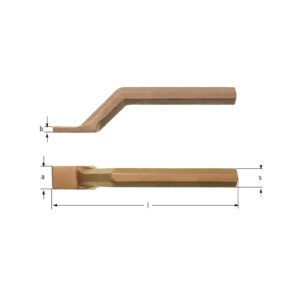
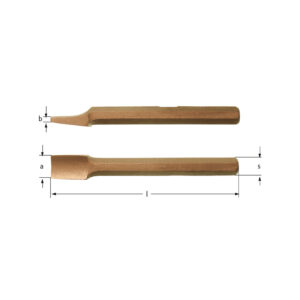
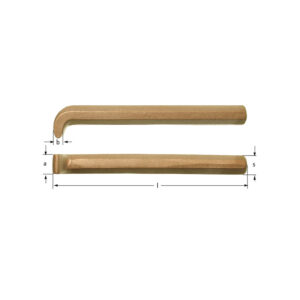
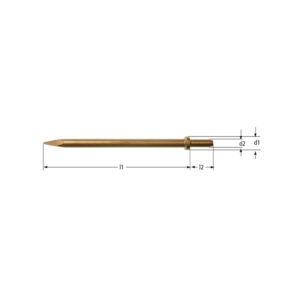
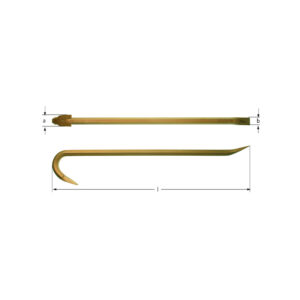
This category includes non-sparking and non-magnetic chisels, wedges and crowbars made from alloys such as aluminium bronze and beryllium copper. These tools are engineered to avoid ignition risks in explosive or flammable atmospheres while remaining durable and safe. Industrial professionals, safety engineers, procurement managers and field technicians often seek these tools for hazardous area compliance and high-risk site applications.
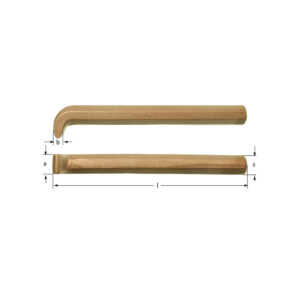
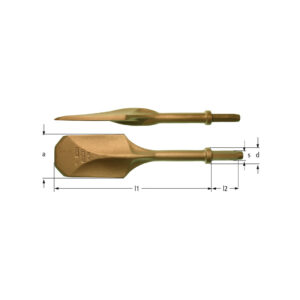
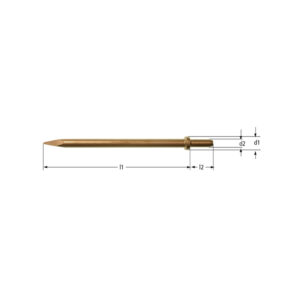
Within this category, industrial buyers will find a range of chisels, wedges and crowbars in non-sparking materials. Examples include pointed-end and flat-end pneumatic chisels, groove chisels, caulking tools (straight and offset), flange wedges, crate openers, pry bars or pinch bars, earthing spikes and wrecking or crowbar bars. Variants are available in both beryllium copper and aluminium bronze. These tools are offered in several sizes, cross-sections, lengths, and tip types.
These non-sparking chisels, wedges and crowbars are used in sectors where fire or explosion hazard is a concern, such as oil & gas, chemical processing, petrochemical plants, mining, or shipbuilding. They enable safe prying, chiselling, spreading, or removing materials without creating sparks. Examples include hazardous area tools, ATEX zone compliance, and explosion proof hand tools. Professionals working in maintenance, shutdowns, or equipment overhaul operations rely on this tool range for safety and regulatory adherence.
Non-sparking chisels, wedges and crowbars are tools designed to perform mechanical tasks—such as cutting, prying, beating or spreading—without producing sparks that might ignite flammable gases, vapors or dust. Key technical characteristics include material composition (primarily aluminium bronze or beryllium copper), magnetic permeability close to unity for non-magnetic behaviour, and sufficient hardness to resist deformation under impact. Sizes are specified in dimensions such as tip width, blade thickness, length and cross-section. Variations include straight tips, offset tips, groove or cape chisels, pneumatic-powered chisels for high-impact work, wedge tools for separation or spreading, and bars for leverage or demolition work.
Standards and certifications are relevant: materials may be tested under EN 80079-38 for low-sparking behavior, and compliance with ATEX directive 1999/92 is often required in many jurisdictions. Selection considerations include the ambient and operational environment (temperature, presence of corrosive substances), required impact energy, the type of force (pneumatic vs manual), component compatibility (e.g. matching wedge size or chisel shank to tool holders), and maintaining tolerances for tip geometry. Durability in use, resistance to wear, and performance under repeated hammering or vibration are also critical factors.
MEMIDOS operates as a global B2B platform connecting industrial purchasers with manufacturers and verified suppliers directly, minimizing intermediary costs. Buyers benefit from secure, escrow-based payment handling where funds are held until supplier meets conditions such as shipment, ensuring protection and reliability. The platform offers access to high-quality industrial products from non-sparking tool specialists, simplifying international procurement. Transparency in sourcing and efficient supplier connections support operational planning, risk management, and compliance with safety regulations.
English
Български (Bulgarian)
Hrvatski (Croatian)
Čeština (Czech)
Dansk (Danish)
Nederlands (Dutch)
Suomi (Finnish)
Français (French)
Deutsch (German)
Ελληνικά (Greek)
Magyar (Hungarian)
Italiano (Italian)
Norsk bokmål (Norwegian Bokmål)
Polski (Polish)
Português (Portuguese (Portugal))
Română (Romanian)
Русский (Russian)
Español (Spanish)
Svenska (Swedish)
Türkçe (Turkish)